
1st Choice Residential journal
Prefab vs. Masonry Fireplace: How to Tell Which One You Have
Two fireplaces look identical behind the screen but follow completely different repair rules. Here is the 60-second test DFW homeowners can run themselves.
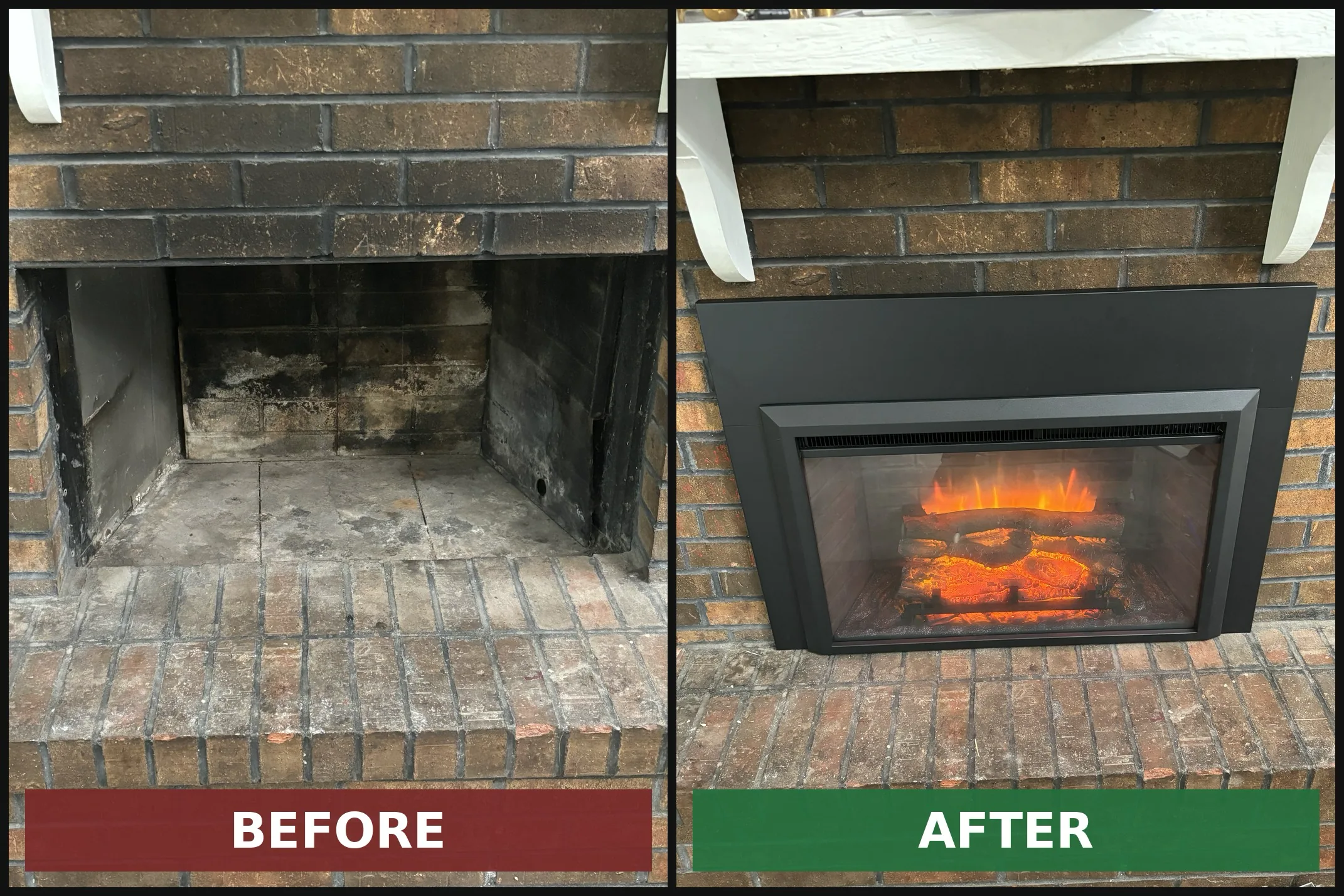
You are standing in front of your fireplace trying to figure out what you actually own. Maybe a chimney sweep used the word prefab and you nodded like you knew what that meant. Maybe a quote to convert it to gas came back higher than you expected. Or maybe you are selling a house in Plano and the inspection report says "factory-built firebox" and you have no idea whether that is good news or bad news.
Here is the short version. There are two completely different products sitting behind the screen in North Texas homes. One was laid brick by brick on a poured footing. The other arrived on a truck as a finished metal box and got framed into a wall. They look nearly identical once the mantel and the stone veneer go on. They are not the same, and the difference decides what can be repaired, what has to be replaced as a whole unit, what it costs, and what a home inspector writes about it.
You can identify yours in about a minute. Grab a flashlight.
The 60-second test: look inside the firebox
Open the doors or pull the screen back and shine a light on the back wall and the side walls. Then look straight up into the damper area.
Signs you have a masonry fireplace
- The walls are individual firebricks with visible mortar joints, usually stacked or laid in a herringbone pattern.
- Looking up, you see a rough cast-iron damper plate and, above it, square or rectangular clay flue tile.
- Outside, the chimney is brick or stone all the way to the ground and sits on its own foundation.
- The whole assembly feels heavy and site-built, because it is.
Signs you have a prefab (factory-built) fireplace
- The walls are large, smooth refractory panels - typically four to six flat gray panels with tight seams, not dozens of individual bricks.
- You can see exposed metal somewhere: a metal lintel across the top of the opening, metal side trim, or a metal frame where the firebox meets the surround.
- Looking up, the damper is a thin steel plate attached to the metal firebox, and the flue above is round metal pipe, not clay tile.
- There is a listing plate - a small metal tag stamped with the manufacturer, model number, and a UL listing - usually inside the firebox on a side wall, on the damper face, or just inside the top of the opening.
- Outside, the "chimney" is a framed and sided chase with a metal cap and shroud on top, often finished to match the house siding rather than brick running to the ground.
That listing plate is the tiebreaker. If you find one, you have a factory-built unit. Every prefab fireplace sold in the United States is built and tested to a national safety standard, UL 127, Standard for Factory-Built Fireplaces. Photograph that plate. It is the single most useful thing you can hand a technician, because parts for these units are model-specific.
Why the difference matters more than homeowners expect
| Question | Masonry fireplace | Prefab / factory-built |
|---|---|---|
| Firebox damage | Repointed or relaid brick by brick | Panels replaced, or the whole unit replaced |
| Replacement parts | Standard masonry materials | Must be parts listed for that exact model |
| After a chimney fire | Inspect, reline, or rebuild | A damaged metal chimney gets replaced, not patched |
| Gas logs or an insert | Wide range of options | Only what the manufacturer approves for that model |
| Service life | Structural; lasts as long as it is maintained | An appliance with a finite service life |
| Common in DFW | Older custom and mid-century builds | Most tract and suburban builds from the 1980s on |
1. The repair rules are stricter on prefab
A masonry fireplace is a structure. A cracked joint gets repointed. A worn firebox gets relaid. A deteriorated flue gets relined. There is almost always a repair path.
A prefab fireplace is a tested assembly. It earned its safety listing as a complete system - that firebox, that chimney pipe, that cap, those panels, from that manufacturer. Swap in a generic part and the assembly is no longer the thing that was tested. That is why a good technician asks for your model number before quoting anything, and why "we will just fabricate something" is the wrong answer on a factory-built unit.
2. Cracked panels have a real threshold, not a judgment call
Refractory panels crack. Heat cycling does it over years, and so does one log dropped hard against the back wall. The working rule chimney professionals use: a crack you can slip a nickel into - roughly 1/16 of an inch - means the panel gets replaced, not patched. Same answer if the panel surface has eroded thin or is crumbling in chunks. The reason is simple. Those panels are what keep firebox heat off the metal shell behind them.
Hairline cracks narrower than that are usually monitored, not replaced. That call is worth making with a camera in the firebox rather than a phone light.
3. A chimney fire ends the conversation differently
The Chimney Safety Institute of America is direct about this: when a factory-built metal chimney is damaged by a chimney fire, it should no longer be used and needs to be replaced. A masonry chimney that takes a chimney fire may be relinable. A prefab one that warps or buckles is done. That is not a scare tactic. It is the difference between a structure and a listed appliance.
4. Going gas is a different project on each
If you want to stop hauling firewood, a masonry firebox gives you the widest menu - vented gas logs, a gas insert, or a full fireplace installation and rebuild. On a prefab wood-burning unit, your options narrow to what the manufacturer approved for that specific model, and some units prohibit gas logs outright. Read our breakdowns on gas logs versus a gas insert and converting a wood-burning fireplace to gas before you shop.
5. It shows up in the home-sale file
Buyers' inspectors across Dallas-Fort Worth flag cracked panels, rusted chase covers, and missing or damaged caps constantly, and those items land on the repair amendment. Knowing which system you have before the inspector arrives is the difference between a scoped repair and a renegotiation. That is the entire point of a home sale inspection done ahead of listing.
Frequently asked questions
How can I tell if my fireplace is prefab or masonry?
Look at the firebox walls and the flue. Individual firebricks with mortar joints plus square clay flue tile above the damper means masonry. Large smooth refractory panels, exposed metal trim, round metal flue pipe, and a stamped UL listing plate mean prefab. The listing plate is the definitive answer.
Is a prefab fireplace less safe than a masonry one?
No. A correctly installed and correctly maintained factory-built fireplace is a tested, listed appliance and performs exactly as designed. The risk with prefab units comes from unapproved parts, missing chase covers, and skipped maintenance - not from the design itself.
How long does a prefab fireplace last?
Manufacturers treat factory-built fireplaces as appliances with a service life rather than permanent structures, so no single number applies to every model. What decides yours is water intrusion through the chase, panel condition, and whether the unit has ever taken a chimney fire. A camera inspection tells you where yours stands.
Do prefab fireplaces need an annual inspection?
Yes. NFPA 211 calls for chimneys, fireplaces, and vents to be inspected at least once a year regardless of type. Prefab units arguably need it more, because the chase, the cap, and the panels are the parts that fail quietly.
Can I replace refractory panels myself?
Panels are sold to the public, but they have to be the panels listed for your model, cut and seated correctly, with the manufacturer's approved refractory mortar. Getting the model wrong or sealing the expansion gaps shut makes the next set crack early. If you are not sure what unit you have, do not guess.
Not sure what you have? We will tell you in writing.
1st Choice Residential has been working on fireplaces and chimneys since 2009. We are veteran-owned, locally owned rather than a franchise, licensed and insured, and our technicians are NFI certified. We will identify your system, photograph the listing plate, and give you a straight answer about what it needs - and what it does not.
- Chimney sweep with camera inspection - $199. Includes identifying your firebox type and documenting panel and flue condition. See what is included.
- Gas fireplace inspection and cleaning - $199. Full safety and operation check.
- Gas fireplace repair - from $199.
- Chimney cap - from $99.
- Every job carries a 1-year workmanship warranty.
Book online in about a minute, or call us: DFW (817) 791-4606 - Gulf Coast (251) 272-1990. You can also iMessage a photo of your firebox to 817-946-8206 and we will tell you what you are looking at.