
1st Choice Residential journal
Vented vs. Ventless Gas Logs: Which One Belongs in Your DFW Fireplace?
Vented gas logs look real but heat poorly. Ventless logs heat well but carry code limits. Here's how DFW homeowners pick the right set — and what it costs.
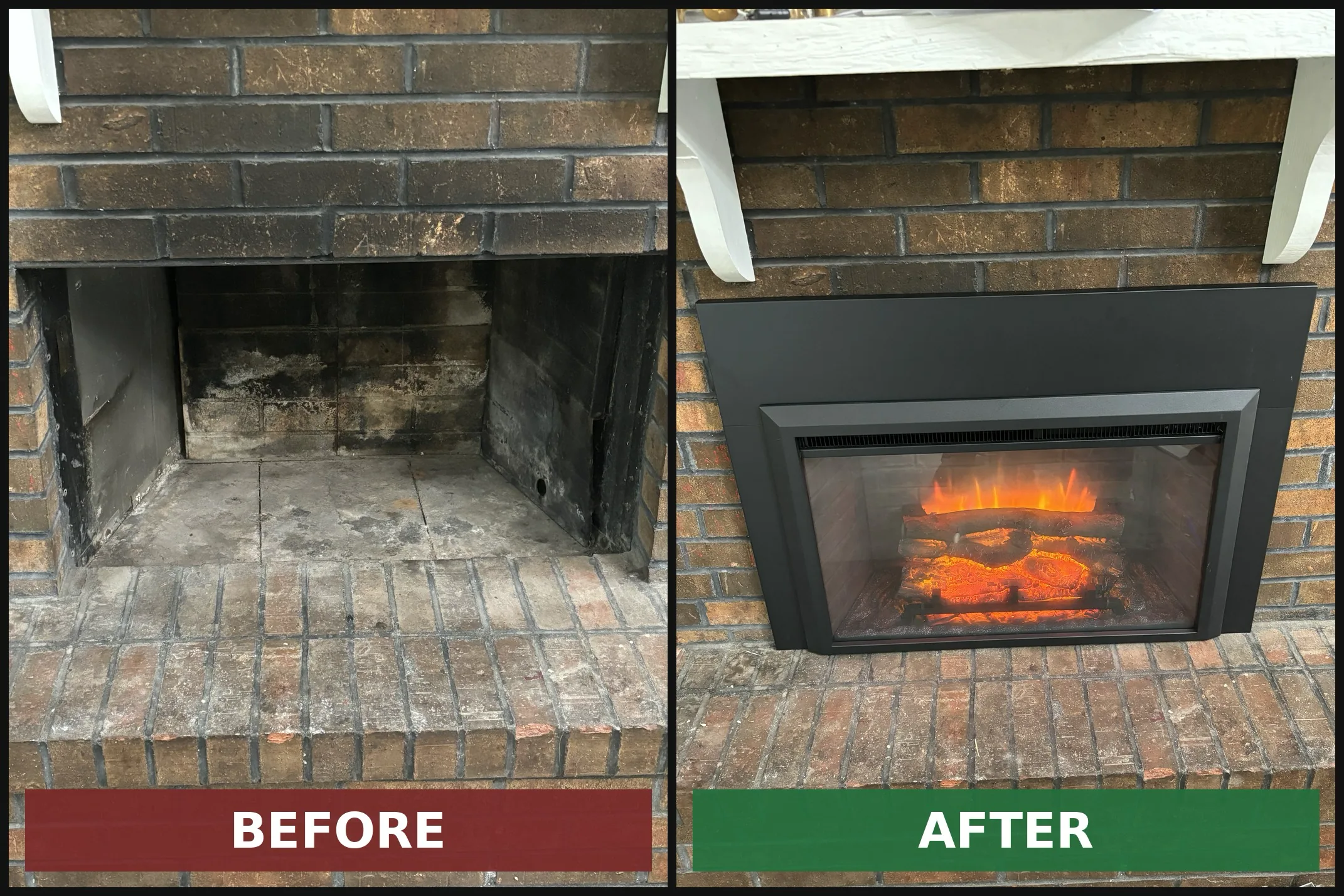
You are standing in a showroom in Plano or scrolling a website at 10pm, and two log sets look almost identical. One is labeled vented. One is labeled ventless (also sold as "vent-free"). The vented set costs less. The ventless set claims 99% efficiency. Nobody has explained why that matters.
Here is the short version: they are two completely different appliances that happen to look alike. One is a fire you watch. One is a heater you run. Picking the wrong one is the most common gas log mistake we fix in Dallas-Fort Worth homes, and it usually gets discovered the hard way — a cold room, a smell, foggy windows, or a home inspector's red flag at closing.
The one difference that drives everything else
A vented gas log set burns with the damper open. Its exhaust goes up the chimney, exactly like a wood fire. Because the flame is allowed to be lazy and yellow, it looks convincingly like burning oak — and because most of the heat goes up the flue with the exhaust, you feel very little of it in the room.
A ventless gas log set burns with the chimney closed. There is no flue. Every bit of heat stays in the room, and so does every bit of combustion byproduct — water vapor, carbon dioxide, and trace amounts of other gases. To make that safe, vent-free appliances are built to the ANSI Z21.11.2 unvented heater standard and must carry an oxygen depletion sensor (ODS) that shuts the burner off before room oxygen falls below roughly 18% (see a manufacturer's vent-free installation manual for the exact language). That same standard is why a certified vent-free set is not allowed to soot.
Side-by-side comparison
| Vented gas logs | Ventless (vent-free) gas logs | |
|---|---|---|
| Damper | Must be blocked permanently open | Closed; no chimney needed |
| Flame look | Tall, yellow, very realistic | Shorter, bluer, more uniform |
| Usable room heat | Very little — most goes up the flue | Nearly all of it stays in the room |
| Typical input | Often 60,000-90,000 BTU/h | Often 10,000-40,000 BTU/h |
| Adds indoor moisture | No | Yes — water vapor is a combustion byproduct |
| Odor complaints | Rare | Common if dust, pet hair, or candles are nearby |
| Code restrictions | Few | Significant — see below |
| Needs a sound chimney | Yes | No |
Where each one actually wins
- You want ambiance in a home that already has central heat. Vented. You have a working chimney, you want the fire to look real, and you are not counting on it for warmth.
- You want to actually warm a cold room. Ventless. A back bedroom over the garage, a converted sunroom, a lake cabin — places your ductwork never conquered.
- Your chimney is damaged, unlined, or expensive to repair. Ventless removes the flue from the equation entirely.
- Anyone in the house has asthma, COPD, or strong chemical sensitivity. Vented. Vent-free appliances put combustion products into the living space by design, and that is a conversation to have with a doctor rather than a salesperson.
- Your home already has humidity problems. Vented. Vent-free burning releases water vapor, and in an already tight, already humid house it can show up as window condensation.
The code rules people miss
Vent-free is not a free-for-all. The 2021 International Fuel Gas Code, Section 303.3 lists sleeping rooms, bathrooms, toilet rooms and storage closets as prohibited locations for appliances, with narrow exceptions for a single wall-mounted unvented room heater — 6,000 BTU/h max in a bathroom, 10,000 BTU/h max in a bedroom, and only if the room meets minimum volume requirements. A hearth-mounted ventless log set is not a wall-mounted heater, so it does not qualify for those exceptions.
Beyond that, adoption varies. California prohibits vent-free appliances outright; several other states have loosened older bans; and plenty of individual cities have their own amendments. Texas does not have a statewide ban, but your city's adopted code and amendments are what govern your permit. Never assume the store checked. Ask before you buy.
Vented sets have one rule that gets ignored constantly: the damper has to be permanently blocked open, usually with a damper clamp, so exhaust always has somewhere to go. If someone installs vented logs and leaves the damper free to close, you have built a carbon monoxide problem into your living room. Log manufacturers spell this out — Rasmussen's own vented guidance is a good example.
The part the showroom skips: your chimney
If you go vented, the gas logs are only half the job. That flue now has to carry exhaust every time you run the fire. A cracked clay liner, a missing chimney cap, or a flue packed with old creosote turns a good log set into a bad idea.
Both NFPA 211 and the Chimney Safety Institute of America point to the same basic habit: get the chimney and venting system inspected annually, and clean it when the inspection says to. That is not a sales pitch, it is the maintenance interval the standard was written around. Our chimney sweep with camera inspection runs $199, and the camera is the part that matters — it shows you the liner instead of asking you to take our word for it.
What this costs in DFW
- Gas fireplace inspection & cleaning: $199
- Gas fireplace repair: from $199
- Chimney sweep + camera inspection: $199
- Chimney cap: from $99
- Workmanship warranty: 1 year on our labor
Log set hardware itself varies widely by size, burner, and brand, which is why we quote it after we see the firebox rather than over the phone.
Frequently asked questions
Are ventless gas logs safe?
A certified vent-free set that is correctly sized, correctly installed in a permitted location, and kept clean is designed to operate safely — the ODS is there specifically to shut it down if room oxygen drops. The risk comes from the common failures: an oversized unit in a small sealed room, a set installed where code does not allow it, or a burner clogged with dust and pet hair. Install carbon monoxide alarms regardless of which type you choose.
Why do my ventless gas logs smell?
Vent-free burners pull room air, and whatever is in that air burns too — dust, pet dander, hairspray, candle wax, cleaning product residue. That is the source of most "gas smell" complaints, and it usually clears up after a proper burner and port cleaning. If you smell raw gas, that is different: leave the house and call your gas utility.
Can I put ventless gas logs in a bedroom?
Generally no. IFGC 303.3 lists sleeping rooms as prohibited locations, and the only exception is a single wall-mounted unvented heater at 10,000 BTU/h or less in a room that meets minimum volume requirements. A hearth-mounted log set does not meet that exception.
Do vented gas logs produce any heat at all?
Some, mostly radiant heat off the log faces and firebox while you are sitting right in front of it. But with the damper blocked open, most of the energy leaves through the flue. If your goal is a warmer room rather than a better-looking fire, vented logs will disappoint you — look at a direct-vent insert or a ventless set instead.
Can I swap my vented logs for ventless in the same fireplace?
Sometimes, but it is not a drop-in. The firebox has to be an approved application for that specific vent-free model, the room needs adequate volume, the gas line and pressure have to suit the new burner, and local code has to permit it. Have it evaluated before you buy hardware.
Not sure which one your house needs?
We would rather look at your firebox than guess. Gas fireplace service across Dallas-Fort Worth is what we have been doing since 2009 — veteran-owned, licensed and insured, NFI-certified technicians, locally owned rather than a franchise.
Book online: Schedule your fireplace inspection
DFW: (817) 791-4606
Gulf Coast: (251) 272-1990
Text or iMessage: 817-946-8206