
1st Choice Residential journal
Scratching in the Chimney? How to Tell What's Living Up There in Mobile, AL
Squirrel, raccoon, bird or bat? What the sound, the timing and the season tell you — plus the one species you are not allowed to remove until it leaves on its own.
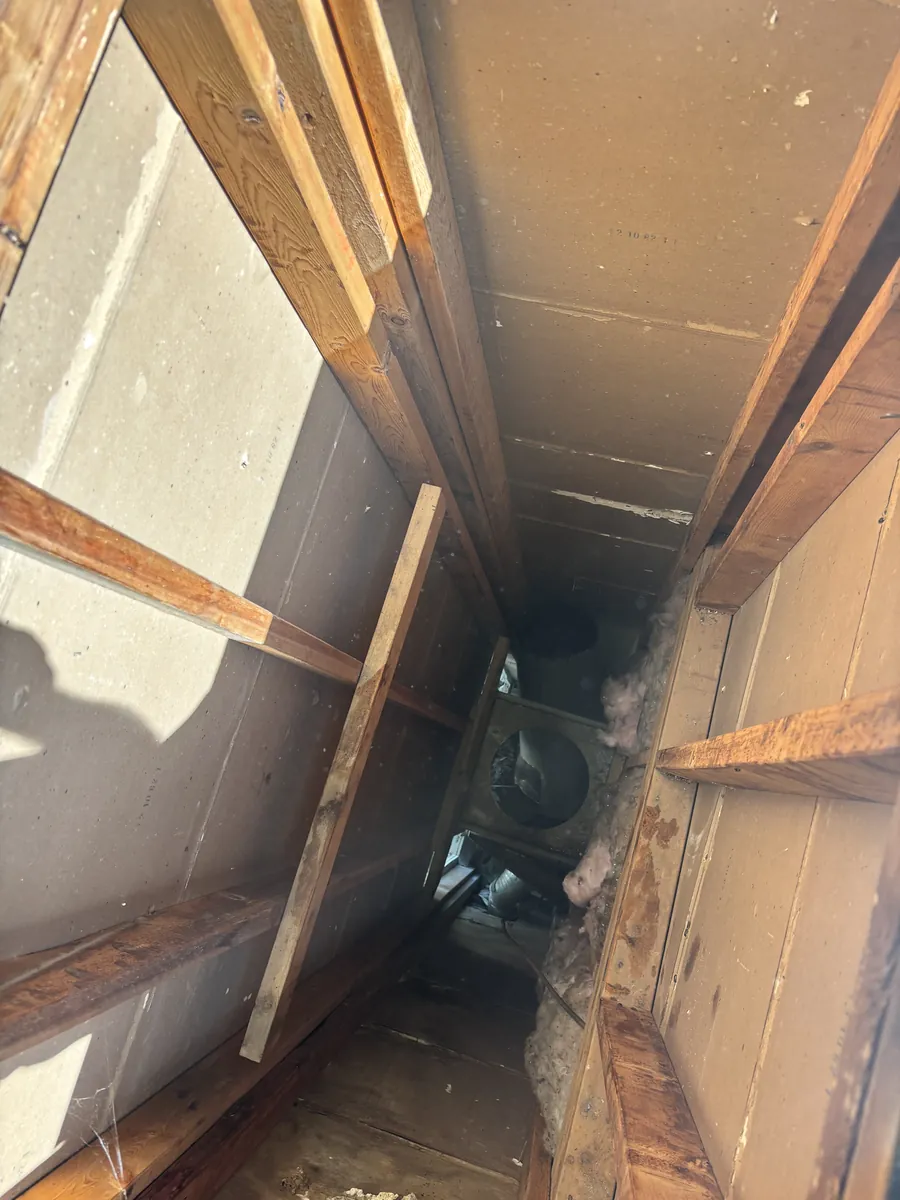
It usually starts at the worst hour. Somewhere above the damper there is a scrape, then a shuffle, then quiet. You stand in the living room with a flashlight pointed up a cold firebox, and you cannot see a thing.
The good news is that you can narrow this down a long way before anyone climbs on your roof. Three clues do most of the work: what the sound is like, what time of day you hear it, and what month it is. Here is how we sort it out on Mobile-area calls.
What the sound tells you
Different animals move differently inside a flue, and the sound carries the difference.
| What you hear | Usually means |
| Light, fast scurrying and scratching, often in the morning | Squirrels |
| Heavy shifting, thumping, low chirring or growling around dusk and overnight | Raccoon |
| Fluttering, flapping against the flue walls, single bird | A bird that fell in and cannot get out |
| Rapid chittering from several birds, deep in the flue, spring through late summer | Chimney swifts |
| Faint scratching or squeaking at dawn and dusk, and a sharp ammonia smell | Bats |
Timing matters as much as texture. Squirrels are daytime animals — if you hear activity while you are making coffee, that is a strong squirrel signal. Raccoons are nocturnal, so evening and small-hours noise points at them. A raccoon in a chimney in spring is very often a female that has chosen your smoke chamber as a den, and there may be kits with her, which changes the job entirely.
The one you cannot just remove
Chimney swifts are worth knowing about before you call anyone, because they are the reason a reputable company will sometimes tell you to wait.
Swifts are a migratory bird species, and the U.S. Fish & Wildlife Service is explicit that the chimney swift is protected under the federal Migratory Bird Treaty Act. They nest inside masonry flues — an uncapped chimney reads to a swift as a hollow tree — and while a nest is active, removing it is not a service anyone can lawfully sell you.
What you can do is plan the fix. Once the birds have fledged and gone, that same chimney gets a proper cap, and the following spring the problem simply does not happen. That is the honest sequence, and any company that offers to "take care of" active swifts today is telling you something about themselves.
Bats have a season too
Bats in a chimney or attic are a real problem and worth solving, but the timing is not up to preference. Alabama Extension guidance is that exclusion devices such as one-way doors should be used outside the pupping season, roughly April through August. Install one while the young are still flightless and you seal them inside — which leaves you with dead animals in a wall cavity and a far more expensive problem than the one you started with.
If you call us about bats in June, we will inspect, tell you plainly what we see, and schedule the exclusion for the right window. That is not us being slow. That is the work being done correctly.
How they got in, and why it is almost always the top
On the Gulf Coast the entry point is rarely a mystery once someone actually looks at it. The usual suspects:
- No cap at all. An open flue is an invitation. It is also the cheapest thing on this list to fix.
- A cap that has rotted out. Salt air off Mobile Bay is hard on galvanized steel and hard on the cheap mesh screens that come on builder-grade caps. A screen that has corroded through at one corner is a doorway.
- A failed chase cover. On a framed chase, the flat cover is a rust point. When the seams open, animals get into the chase itself and then into the house.
- Damaged crown or flashing. Gaps at the crown give squirrels a start, and they will widen what they find.
This is why we treat removal and exclusion as one job rather than two. Taking the animal out and leaving the hole open means you have bought yourself a season, not a solution.
What to do tonight
A few things genuinely help, and a few popular ideas make everything worse.
Do: close the damper if you can do it safely, so nothing gets into the room. Keep pets and kids away from the fireplace. Write down when you hear the noise — it is better diagnostic information than anything you will get from a photo.
Do not: light a fire to drive the animal out. It does not reliably work, it is cruel, and with a nest in the flue you are lighting a fire on top of dry tinder in an unlined space. Do not pour anything down the chimney. Do not reach in.
And if the animal is loose in the house rather than in the flue, open one exterior door, close the interior doors, and leave the room. Most animals leave on their own given a clear exit.
What it costs
Animal removal runs $180 to $560, set by the animal, how hard it is to reach, and how much time the job takes. A bird sitting in an open flue and a raccoon that has denned above the damper are not the same afternoon. You get the number before we start.
Exclusion and repair are quoted after we see the entry point, because a loose cap and a chewed-open soffit are genuinely different jobs and pricing them sight-unseen is how people get surprised. If the fix turns out to be a cap, chimney caps start at $99. If the flue needs sweeping after nesting material comes out, a chimney sweep and Level 1 inspection is $229.
Frequently asked
How do I know if something is in my chimney or in my attic?
Sound location is the best clue. Chimney noise is contained and echoes — it seems to come from one vertical spot near the firebox. Attic noise moves horizontally above the ceiling, often toward one corner of the house. If you are hearing both, you may have an animal that got into the chase and then into the attic space.
Will the animal leave on its own?
Sometimes. A bird that fell into a flue often cannot get out, because smooth clay tile gives nothing to climb. A squirrel usually can. A raccoon with young will not leave until the young can travel. Waiting is a reasonable first step for a day or two, but not a plan.
Is a chimney cap enough to keep animals out?
A properly fitted cap with intact screening is the single most effective thing you can put on a chimney to limit animal entry, and it also keeps rain and debris out of the flue. It has to actually fit the flue and be in good condition — a corroded cap is worse than it looks from the ground.
Do you handle the mess afterward?
Yes. Droppings cleanup and odor treatment are part of what we quote when they are needed. Nesting material in a flue is also a real fire concern, so it comes out rather than getting pushed aside.
Talk to someone who will look before quoting
1st Choice Residential has been working on chimneys and fireplaces since 2009. We are veteran-owned, licensed and insured, and locally owned rather than a franchise. Animal removal is offered across Mobile and Baldwin County.
Call the Gulf Coast line at (251) 272-1990, or book online. Tell us what you are hearing, where in the house, and what time of day — that gets us most of the way there before we arrive. Full details on the animal removal service page.