
1st Choice Residential journal
Can You Convert a Propane Grill to Natural Gas? An Honest DFW Guide
You have a gas stub on the patio and a propane grill. Whether you can connect the two depends almost entirely on your grill's brand. Here's the honest answer.
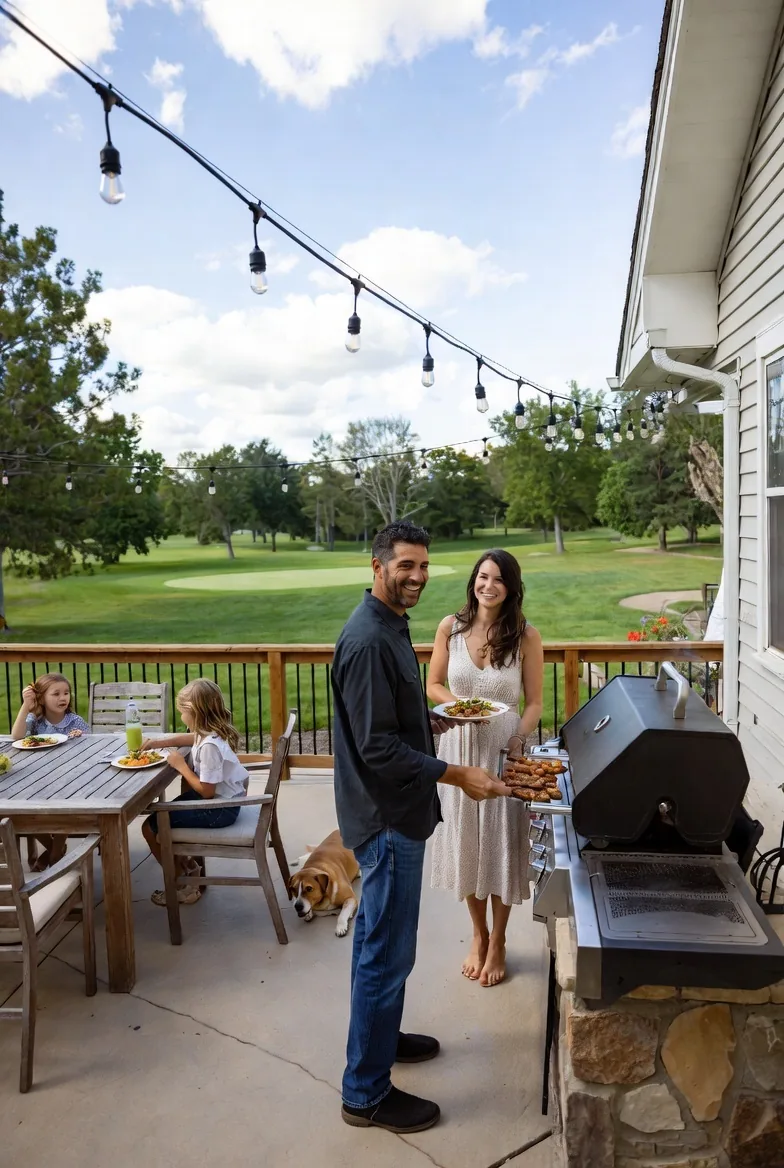
You have a natural gas stub sitting on the patio because the builder ran one. You also have a propane grill and a 20-pound tank that always runs dry halfway through a brisket. So the obvious question: can you just hook the grill up to the gas line?
Sometimes. But "sometimes" is doing a lot of work in that sentence, and the answer depends almost entirely on who made your grill. Here is the straight version, with the part most conversion-kit sellers leave out.
The short answer
Propane and natural gas are not interchangeable. A grill built for one fuel will not run correctly on the other without changing hardware inside the grill. Some manufacturers sell a factory conversion kit for that. Others — including Weber — refuse to sell one at all and will void your warranty if you convert anyway.
If your grill has a factory kit available, conversion is a real option. If it does not, the honest answer is that you are better off buying a natural gas grill than modifying the one you own.
Why you can’t just swap the hose
The two fuels carry wildly different amounts of energy in the same amount of space, and they arrive at the burner at different pressures. Propane packs roughly 2,500 BTU per cubic foot. Natural gas carries about 1,030 BTU per cubic foot — right around 41% of propane’s energy density (Fire Pit Surplus conversion reference).
That means to get the same heat out of the same burner, natural gas has to flow through a noticeably larger opening. And the pressure feeding it is different too.
| Propane (LP) | Natural Gas (NG) | |
|---|---|---|
| Energy per cubic foot | ~2,500 BTU | ~1,030 BTU |
| Typical manifold pressure | ~11 in. water column | ~3.5–7 in. water column |
| Burner orifice | Smaller | Roughly 1.6× larger in diameter |
| Fuel supply | Portable tank | Fixed line, never runs out |
Run natural gas through propane-sized orifices and you get a weak, lazy flame and a grill that never reaches searing temperature. Run propane through natural-gas-sized orifices and you get the opposite — a dangerously over-fueled burner, yellow flames, sooting, and heat where it does not belong.
This is why swapping only the hose or only the regulator is not a conversion. A correct conversion changes the orifices and the regulator, and on many grills the valves and manifold too.
Which grills can actually be converted
Weber says no. Weber does not sell conversion kits for its gas grills and states plainly that converting one will void the warranty and may create an unsafe situation. Their reasoning is the complexity of the gas train and the amount of disassembly required (Weber’s official position).
Most premium built-in brands say yes. If you have a built-in grill in an outdoor kitchen, you are in much better shape. Factory conversion kits exist for many models from:
- DCS — model-specific LP-to-NG and NG-to-LP kits (DCS spare parts)
- Coyote — kits for CL and SL-series grills (Coyote conversion kits)
- Lynx — kits covering the 27-inch through 54-inch grill sizes
- Blaze — kits available for many current models
The critical word is model-specific. A kit for a 30-inch grill is not the right kit for the 36-inch version of the same line. Order by your model number off the data plate, not by brand alone.
What a proper conversion actually involves
- Confirming your exact model has a factory-approved kit
- Replacing every burner orifice, including side burners and rotisserie or infrared burners
- Replacing or adjusting the regulator for the new supply pressure
- Converting or replacing valves where the manufacturer requires it
- Adjusting the low-flame setting on each valve so burners do not blow out on low
- Leak-testing every connection under pressure
- Checking flame quality on every burner — blue, stable, no yellow tipping
- Applying the fuel-conversion label the kit ships with
The gas line itself is separate work. Outdoor cooking appliances are built to CSA/ANSI Z21.58 and are required to be installed per the National Fuel Gas Code, ANSI Z223.1/NFPA 54 (ANSI standard overview). Running or extending that line is a licensed gas fitter’s job, and in most DFW cities it needs a permit.
The Amazon-kit problem
Search "Weber natural gas conversion kit" and you will find plenty for sale. None of them are Weber parts. They are third-party hoses and orifices sold for a grill whose manufacturer specifically says not to do this.
If one of those kits causes a fire or a gas leak, you are outside the manufacturer’s approval, outside the warranty, and likely outside what your homeowners policy wants to hear about. That is not scare talk. It is just where you end up standing when nobody’s engineering signed off on the change.
Our honest take: if there is no factory kit for your grill, put the conversion money toward a natural gas grill instead. You will spend less over five years than you will chasing a modified grill that never quite runs right.
When conversion is worth it — and when it is not
Worth it if: you own a premium built-in grill with a factory kit, the cabinet already has gas plumbed to it, and the grill body is in good shape. Converting a $3,000 built-in beats replacing it.
Not worth it if: the grill is a portable propane unit, the burners are already rusted through, the firebox is flaking, or no approved kit exists. At that point you are pouring money into a grill that is near the end anyway. We broke that decision down in our guide on repairing versus replacing a built-in gas grill.
Frequently asked questions
Can I convert a propane grill to natural gas myself?
Only if your manufacturer sells an approved kit for your exact model, and even then it involves replacing orifices, changing the regulator, adjusting low-flame settings, and leak-testing under pressure. Most manufacturers require the work be done by a licensed gas professional. If no factory kit exists for your grill, the answer is no.
Does converting a grill void the warranty?
It depends on the brand. Using the manufacturer’s own conversion kit generally keeps the warranty intact. Weber, which sells no conversion kits at all, states that converting one of their grills voids the warranty regardless of the method used.
Will my grill lose power on natural gas?
Not if it is converted correctly. A properly converted grill produces the same BTU output on either fuel, because the larger orifice compensates for natural gas’s lower energy density. Loss of heat almost always means the orifices were never changed, or the wrong size was installed.
Is natural gas cheaper than propane for grilling?
For most DFW households, natural gas is the lower cost per BTU, and you never lose a cook to an empty tank. The tradeoff is that the grill is now tethered to a fixed line and cannot be moved.
How do I tell which fuel my grill is set up for?
Check the rating plate, usually on the back panel or inside the cart door. It lists the fuel type, the manifold pressure, and the model number you need to order any kit. If someone converted it before you owned it, there should be a conversion label next to the original plate.
Not sure what you are working with? Let us look at it.
Before you spend a dollar on a conversion kit, it is worth knowing whether the grill underneath is worth converting. Our NFI-certified technicians will pull the grates and heat shields, check the burner and firebox condition, verify your fuel type off the data plate, and tell you honestly whether this grill has five more years in it or five more months.
If it has life left, a professional grill deep clean and repair starts at $239 and comes with our 1-year workmanship warranty. We serve homeowners across Dallas–Fort Worth and the Gulf Coast, and we have been doing this since 2009 — veteran-owned, licensed and insured, locally owned rather than a franchise.
Book online: Schedule your grill service
DFW: (817) 791-4606 | Gulf Coast: (251) 272-1990 | Text us: 817-946-8206