
1st Choice Residential journal
Can You Grill on a Balcony? Apartment and Condo Rules Explained
Can you grill on a balcony? Most apartments ban charcoal and full-size propane grills. Here are the fire code rules, the exceptions and the safe options.
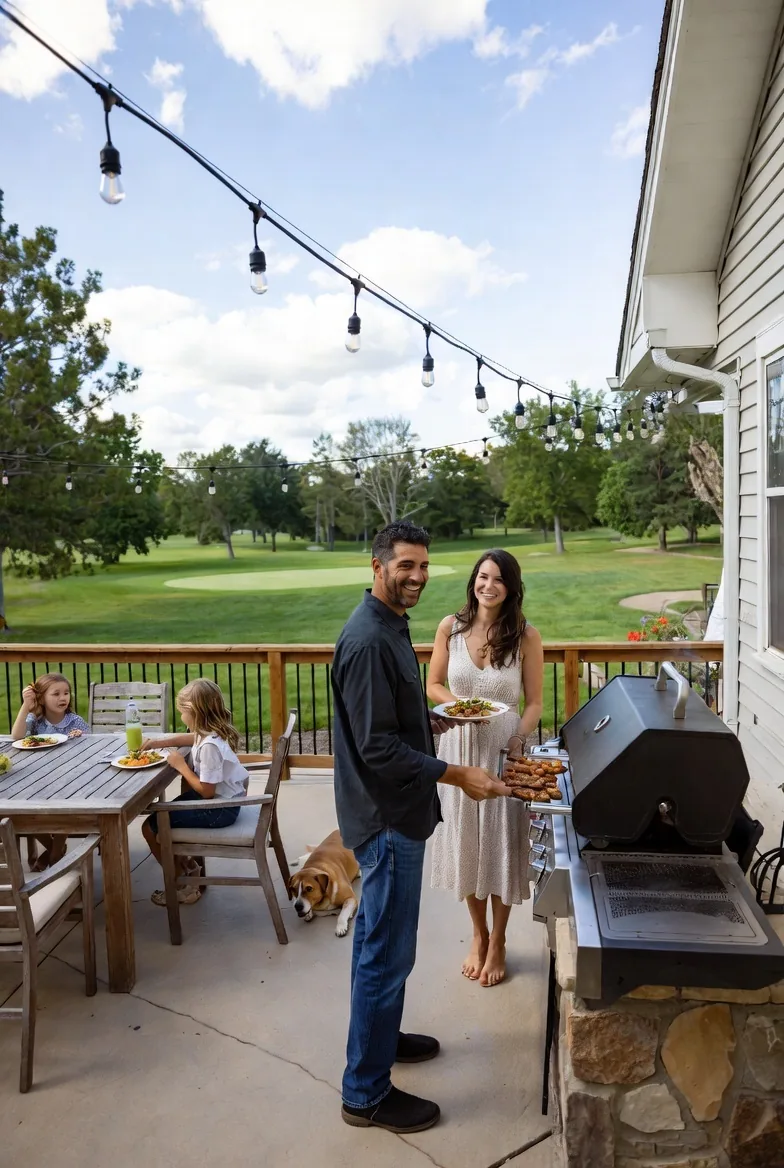
Usually no, if you live in an apartment or condo. Most cities follow the International Fire Code, which bans charcoal and other open-flame grills on combustible balconies and within 10 feet of combustible construction in multifamily buildings. The big exceptions: sprinklered buildings, single-family and duplex homes, and tiny grills running on a 1 lb propane cylinder. Electric grills are usually fine.
Quick answer
- Apartment or condo with a wood balcony: no charcoal, no 20 lb propane grill, unless the building has sprinklers.
- A tabletop grill on a 1 lb propane cylinder is the code's small-grill exception.
- Electric grills are not open flame and are usually allowed. Check your lease.
- House, duplex or properly separated townhome: grill away, just keep it away from walls, railings and eaves.
Thanksgiving is Thursday. Your cousin just moved into a third-floor apartment, offered to host, and is now eyeing that little balcony like it is a backyard. We get it. The balcony has a view, the kitchen has one oven, and Aunt Linda's casserole has already called dibs on it. Before anyone hauls a kettle grill up two flights of stairs, here is what the rules actually say and what you can do instead.
Can you grill on a balcony under the fire code?
Not with an open flame on a combustible balcony of an apartment building, unless the building is sprinklered. Section 308.1.4 of the International Fire Code says charcoal burners and other open-flame cooking devices shall not be operated on combustible balconies or within 10 feet of combustible construction. The New York Department of State lays out the exact wording and its three exceptions in a plain technical bulletin (NY Department of State, TB-3005):
- One- and two-family dwellings.
- Buildings, balconies and decks protected by an automatic sprinkler system.
- Propane cooking devices with a container of 2.5 lb water capacity or less. That is the 1 lb green camping cylinder.
Cities in Texas and Alabama base their rules on a version of this code, often with local changes. So the code is the starting point, and your city, your fire marshal and your lease can only make it stricter, never looser.
Which grills are allowed on an apartment balcony?
Electric grills and small 1 lb propane grills are the usual winners. Charcoal and full-size propane grills are the usual losers. Here is how it shakes out for most buildings.
| Where you live | Charcoal grill | 20 lb propane grill | 1 lb propane tabletop | Electric grill |
|---|---|---|---|---|
| Apartment or condo, wood balcony, no sprinklers | No | No | Code allows it | Usually yes |
| Apartment or condo, sprinklered building | Code allows it, lease may not | Code allows it, lease may not | Yes | Yes |
| Concrete balcony, more than 10 ft from anything combustible | Ask the fire marshal | Ask the fire marshal | Yes | Yes |
| House or duplex deck | Yes, with clearance | Yes, with clearance | Yes | Yes |
The lease is the wild card. Plenty of complexes ban every grill except electric, and some ban those too. Read the community rules before you buy anything. It beats explaining a new grill to the property manager.
How do you grill safely on a balcony when it is allowed?
Treat a balcony grill like a campfire in a phone booth: small, watched and far from anything that burns. These steps keep the cookout fun and the fire trucks home.
- Read the lease and HOA rules first. Take a photo of the grill section so you can show your host or the property manager.
- Pick the right grill. Electric or a tabletop grill on a 1 lb cylinder. Leave the 20 lb tank at the store.
- Find the most open spot. Keep it away from the sliding door, siding, railings, patio furniture cushions and anything hanging overhead.
- Set it on a stable, nonflammable surface. A wobbly plant stand is not a grill stand.
- Make a kid and pet zone. The National Fire Protection Association says to keep children and pets at least 3 feet from the grilling area (NFPA grilling safety). A strip of painter's tape on the floor makes a great "lava line" for little ones.
- Clean the grease. NFPA says to remove grease and fat buildup from the grill and the trays below it. Small grills have small drip trays that fill fast.
- Never leave it. Turn it off, close the cylinder valve and let it cool before anyone walks away.
- Keep a fire extinguisher or a lid handy. Never throw water on a grease flare-up.
Is it safe to grill on a house deck or townhome patio?
Yes, one- and two-family homes are exempt from the balcony rule, and many areas treat properly separated townhomes the same way. Exempt does not mean careless. NFPA says to place the grill well away from the home, deck railings and out from under eaves and overhanging branches. If your grill lives under a covered patio, our guide to built-in grill clearances under a covered patio walks through what to measure.
And keep the propane tank outside, upright and out of the living space, not in the garage or a closet. Our post on leaving a propane tank outside in the heat covers where the tank should live.
What our techs see
When our techs clean grills at townhomes and smaller homes, the most common problem is not the grill. It is where the grill lives: pushed up against vinyl siding or tucked under a low eave because that is where it fit. The other one is a small portable grill with a drip tray packed with old grease, the kind that turns a burger into a bonfire. Both are easy fixes. Pull the grill out into the open and empty that tray before every cook.
DIY stops here
Reading your lease, picking an electric or 1 lb grill and setting up a safe spot are all yours. Call a pro when a gas grill smells like gas, the flames run yellow and lazy, the burner tubes are rusted through, or the grease has baked into the firebox so deep that scraping does nothing. A professional BBQ grill cleaning gets your grill guest-ready, and our grill deep clean starts at $239 with a 1-year workmanship warranty. The payoff is a grill that lights on the first click and a host who looks like they have it all together.
Where we serve
1st Choice Residential cleans and repairs grills across Dallas-Fort Worth at (817) 791-4606, and across Mobile and Baldwin County, AL, including Pensacola, FL, at (251) 272-1990. Book online here and pick a time that works before the holiday rush.
Frequently asked questions
Can you grill on an apartment balcony?
Usually not with charcoal or a full-size propane grill. The International Fire Code, which most cities use as a base, bans open-flame cooking on combustible balconies of apartment buildings and within 10 feet of combustible construction unless the building has sprinklers. A small grill on a 1 lb propane cylinder or an electric grill is often allowed. Check your lease and local fire marshal.
Can I use a 20 lb propane grill on my condo balcony?
In most apartment and condo buildings, no. The model fire code exception for balconies covers only propane cooking devices with a container of 2.5 lb water capacity or less, which is the small 1 lb camping cylinder. A standard 20 lb tank grill needs a sprinkler-protected building or open ground at least 10 feet from the structure.
Are electric grills allowed on balconies?
Electric grills have no open flame, so the fire code rule on open-flame cooking does not cover them, and many apartment communities allow them. Your lease or HOA can still ban them. Plug into an outdoor-rated GFCI outlet, skip extension cords, keep grease cleaned off, and keep kids and pets 3 feet back.
Can I grill on the deck of my house or townhome?
Yes. The fire code exempts one- and two-family homes, and many areas treat properly separated townhomes the same way. NFPA still says to keep the grill well away from the house, deck railings and overhanging eaves or branches. 1st Choice Residential can clean and check your grill before guests arrive in DFW, Mobile or Baldwin County.
Who decides the grill rules for my building?
Three layers apply. Your city's adopted fire code sets the floor, your local fire marshal interprets it, and your lease, condo rules or HOA can be stricter. In DFW and Mobile, call the fire department's non-emergency line if your lease is unclear. The strictest rule is the one that applies to you.
Written by the 1st Choice Residential team. Veteran-owned since 2009, NFI-certified techs, serving DFW and Mobile & Baldwin County.