
1st Choice Residential journal
Can You Put a Built-In Grill Under a Covered Patio? DFW Clearance Rules
Your builder framed a covered patio and left a grill cutout under it. Here are the real overhead, wall, and island venting clearances before you drop in a grill.
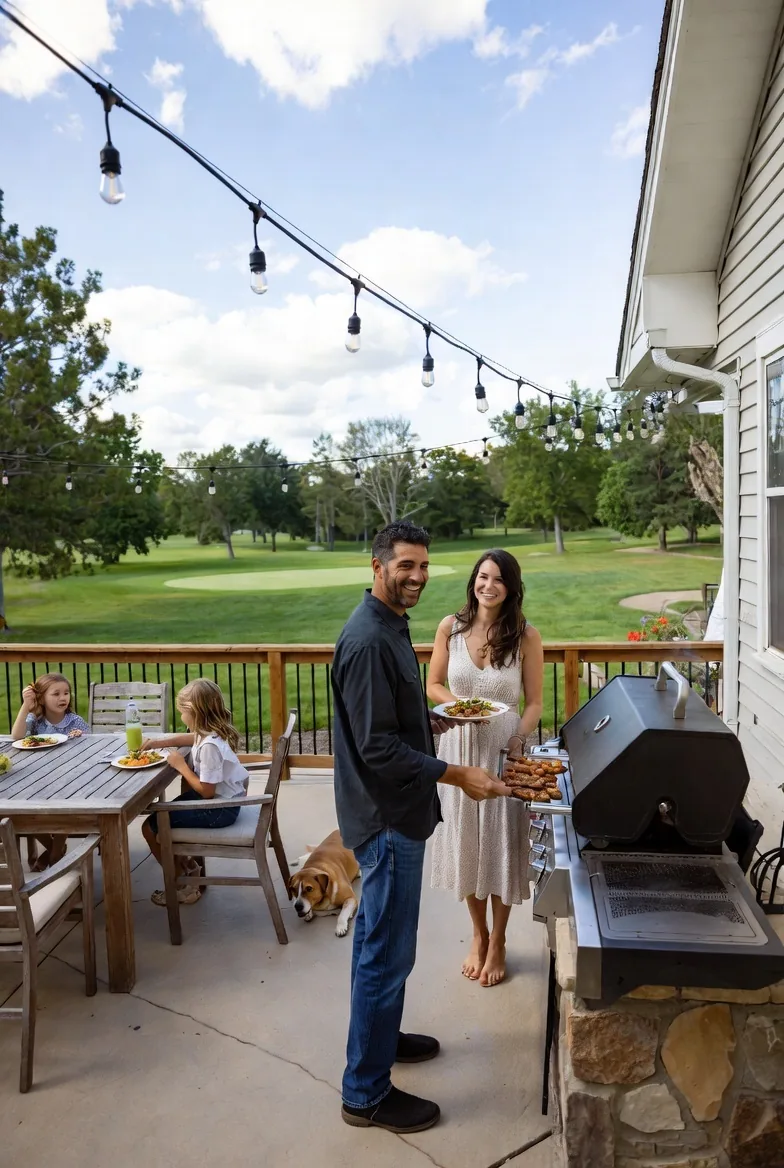
You are standing on a fresh concrete slab in Frisco or Mansfield, looking up at the cedar ceiling of a brand-new covered patio. Below it, the mason left you a stone island with a rectangular hole in the counter. The hole is grill-shaped. The assumption is obvious.
Then you open the install manual for the grill you picked out, and the first page says something that stops you cold: do not use this appliance under an awning.
So which is it? Can a built-in gas grill go under a covered patio or not? The honest answer is: sometimes, and it depends almost entirely on what the ceiling is made of, how high it is, and what your specific grill's manufacturer allows. Here is what the manuals actually say.
The three numbers that decide everything
Nearly every built-in grill manual answers the covered-patio question with the same three variables. Get these right and the rest is detail work.
- Height from countertop to ceiling. American Outdoor Grill, for example, requires a minimum 5-foot clearance between the countertop and any overhead construction in its built-in installation manual. A standard 8-foot patio ceiling over a 36-inch counter clears that. A low pergola or a dropped soffit may not.
- What the ceiling is made of. Combustible (wood decking, cedar tongue-and-groove, painted plywood) versus non-combustible (stucco over metal lath, concrete, certain rated assemblies). Your city decides which is which, not the internet.
- Whether there is a hood. AOG's manual is direct about it: under combustible overhead construction, the area above the cooking surface must be covered by an exhaust hood, and the grill must not be used under unprotected combustible overhead construction at all. Under non-combustible overhead, a hood is highly recommended rather than required.
If a hood is in play, AOG specifies it must be larger than the grill's cooking area and rated at a minimum of 1,200 CFM for outdoor use. That is a real hood with a real duct run, not a decorative stainless canopy.
Some brands say no. Full stop.
This is the part that catches people after the island is already built.
Wolf states plainly in its outdoor grill clearance guidance that its outdoor grills, side burners, and burner modules cannot be installed in any enclosed or covered area with a roof or overhang — including the eave overhang of a roof. Wolf also holds that combustible material cannot sit within 12 inches of the side or rear of the grill regardless of how high above the grill it is.
Read that twice. Under a Wolf reading, a hood does not buy you permission; the covered patio is simply out of bounds for that appliance. A different brand under the same roof might be fine with a hood. Same patio, same ceiling, opposite answers.
The takeaway is not that one brand is right. It is that you pick the grill after you know the ceiling, not before. Buying a $6,000 grill head and then discovering its manual forbids your patio is an expensive way to learn this.
Side and rear walls matter more than people think
Overhead is only half of it. AOG's manual gives three side and rear clearance cases, and the spread between them is dramatic:
| Wall type | Minimum side and rear clearance |
|---|---|
| Strictly non-combustible wall (brick, for example) | 4 inches |
| Protected combustible wall (non-combustible barrier in front of framing) | 14 inches |
| Combustible wall | 18 inches |
A non-combustible backsplash still needs 4 inches of clearance behind the grill so heat can escape. That 4 inches is why a grill jammed tight against a stone backsplash cooks its own control panel and burns up igniter wiring over a couple of seasons.
NFPA's general grilling guidance points the same direction for any grill: keep it well away from the house, deck railings, and out from under eaves and overhanging branches, and at least 3 feet from anything that can burn, per its grilling safety tip sheet.
The vents in the island are not optional
Here is the failure we see most often in DFW outdoor kitchens, and it has nothing to do with the roof. A mason builds a beautiful sealed stone box, sets the grill in the top, runs the gas, and cuts no vents. It looks perfect. It is a gas trap.
Gas behaves differently depending on which kind you have:
- Propane is heavier than air. A slow leak pools at the bottom of the island. Venting low is what protects you.
- Natural gas is lighter than air. It collects at the top of a sealed enclosure. Venting high is what protects you.
Because either gas can be the one in your island, AOG requires venting at both levels: either one side of the enclosure left completely open, or a minimum of four openings — two in the side walls at the top and two at floor level, spaced at least 90 degrees apart, each with at least 10 square inches of free area for a total of 40. Top openings start within 1 inch and end no more than 5 inches below the countertop; bottom openings do the same from the floor. Vents must stay unobstructed, with 6 inches of clearance to anything outside the island and 2 inches to anything inside it.
If a propane cylinder lives inside the island, there is more: a non-combustible heat shield over the regulator and cylinder valve, the cylinder resting at least 2 inches off the ground, a CSA-listed stainless flex connector, and an additional vent opening recommended near the cylinder at the gas connection level. And if the enclosure itself is built of combustible material, AOG requires an insulating liner around the grill.
What you can check yourself, and where to stop
Grab a tape measure and do this much on your own:
- Measure countertop to ceiling. Under 5 feet is a problem for most brands.
- Look at your ceiling material and be honest about whether it is wood.
- Walk the island and count vent openings. Zero vents means stop using the grill until it is corrected.
- Measure the gap behind the grill to the backsplash.
- Pull your grill's actual manual — the model number is usually on a tag behind the control panel — and read its overhead section.
Stop and call a pro if any of this is true: you smell gas at any time, the island has a propane tank inside with no vents, the grill sits under wood decking with no hood, the gas line was run by someone unlicensed, or you are cutting into a finished stone island. Gas line work and enclosure modifications are not weekend projects, and in most DFW cities the gas connection is permitted and inspected work.
One thing we will not do is tell you what your particular city will approve. Permit requirements vary between Dallas, Fort Worth, and every suburb in between, and the inspector who signs off on your patio is the authority on your patio. Call your city's permit office before the stone goes up, not after.
Frequently asked questions
Can you put a built-in grill under a covered patio?
Often yes, but only if your grill's manufacturer allows it. Most brands require a minimum overhead clearance — 5 feet from countertop to ceiling in American Outdoor Grill's manual — and require a vent hood when the ceiling is combustible. Some brands, including Wolf, prohibit installation under any roof or overhang entirely. Check your specific model's manual before you build.
How high does a patio ceiling need to be above a built-in grill?
American Outdoor Grill specifies a minimum 5-foot clearance between the countertop and the overhead construction. Other manufacturers publish their own numbers, so measure from your finished counter height to the lowest point of the ceiling, including beams and soffits, and compare that to your manual.
Do I need a vent hood over an outdoor grill?
Under combustible overhead construction such as a wood patio ceiling, AOG requires an exhaust hood covering the cooking surface, sized larger than the cooking area and rated at a minimum of 1,200 CFM. Under non-combustible overhead construction, a hood is strongly recommended but not required by that manual.
Does a built-in grill island need vents?
Yes. Propane pools at the bottom of a sealed enclosure and natural gas collects at the top, so an island needs venting at both levels. AOG's requirement is either one fully open side or four openings — two high, two low, spaced at least 90 degrees apart, each at least 10 square inches of free area.
How much does it cost to have a built-in grill cleaned and inspected?
A professional grill deep clean starts at $239. During that visit we can also look at your clearances, vent openings, and burner condition. Repairs are quoted after we see the grill, because a corroded burner and a failed valve are different jobs and we are not going to guess at a price over the phone.
Building an outdoor kitchen in DFW? Talk to someone who services them
1st Choice Residential has been working on grills, fireplaces, and chimneys since 2009. We are veteran-owned, locally owned rather than a franchise, licensed and insured, and our technicians are NFI-certified. We back our workmanship with a 1-year warranty.
If your grill is already installed under a patio and you want a second set of eyes on it — or it is running poorly and you suspect the enclosure is part of the reason — a BBQ grill cleaning and repair visit is the place to start. We serve the entire Dallas–Fort Worth metroplex, including Southlake.
Call (817) 791-4606 in DFW, or text 817-946-8206 if that is easier. You can also book online and pick your own time.