
1st Choice Residential journal
Cracked Firebox Panels: When It's Normal and When Your DFW Fireplace Needs Repair
Hairline cracks in your firebox are normal. Some cracks aren't. Here's the exact line, and why the crack width everyone quotes online may not apply to you.
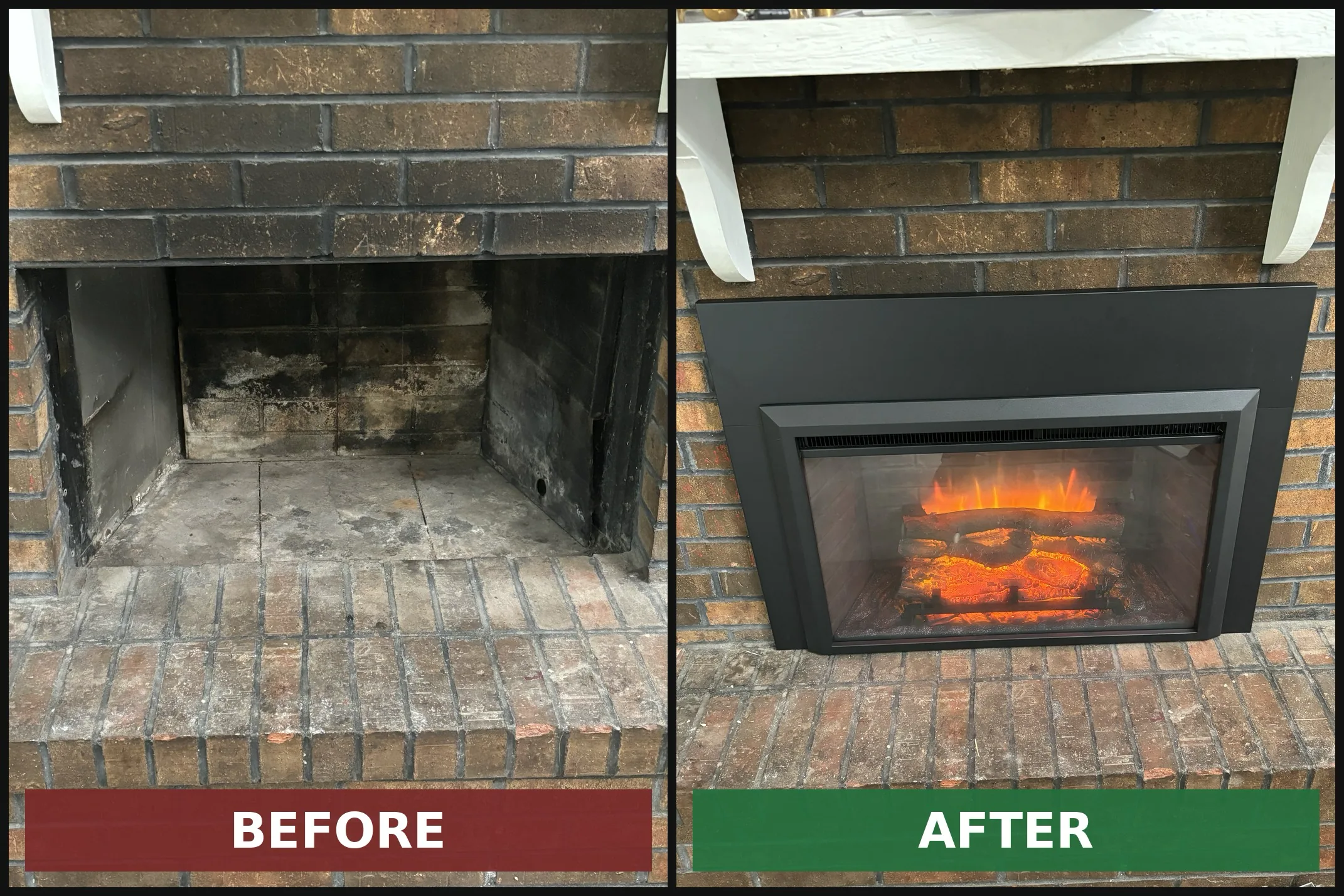
You shine a flashlight at the back wall of your firebox and there it is: a web of cracks running through the panel. Some are hairline. One or two look wider than that. Maybe a corner has crumbled off onto the floor of the firebox.
So which is it — a fire hazard, or the normal condition of a 20-year-old fireplace?
Honest answer: most of what you are looking at is probably normal. Some of it isn't. The line between the two is narrower than most homeowners expect, and it is also something you can check yourself in about two minutes with a flashlight and a coin.
This guide covers factory-built (prefab) fireplaces, which is what a lot of Dallas–Fort Worth homes built from the 1980s onward have, and masonry fireboxes too. If you are not sure which one you own, our guide on how to tell a prefab fireplace from a masonry one sorts that out fast.
What those panels are actually doing
In a factory-built fireplace, the light-colored panels lining the back and sides of the firebox are refractory — a cast, cement-like material built to take direct flame contact. They are not decoration. They sit between your fire and the sheet metal shell of the fireplace, and behind that shell is wood framing.
Their whole job is to absorb heat and keep it off the metal. When a panel breaks down badly enough to expose that metal, heat starts reaching parts of the assembly that were never tested to handle it. That is the actual risk — not the crack itself, but what the crack eventually leads to.
A masonry firebox does the same job with firebrick and refractory mortar. Same principle, different material, different repair.
Cracks that are normal (really)
Refractory expands when it heats and contracts when it cools. Do that a few hundred times and it will craze. Manufacturers say so plainly in their own manuals. Hearth & Home Technologies, which builds Heatilator fireplaces, tells owners in the MEL36/MEL42 manual that “small hairline cracks and discoloration are normal and do not affect its safety.”
Soot staining is normal. Uneven color is normal. A fine spiderweb pattern you can barely feel with a fingernail is normal.
What is not normal is material actually leaving the panel.
The crack width that actually governs your fireplace
Search this topic and you will find the same number everywhere: replace the panel when a crack is 1/16 of an inch — about the thickness of a nickel's edge. It is a useful field rule of thumb, and plenty of sweeps use it.
But it is not the number that governs your fireplace. Your manufacturer's manual is. A factory-built fireplace is a listed appliance, tested as a complete assembly to UL 127, and the maintenance spec in its manual is the one that applies. Those specs are not all the same. The Heatilator MEL36/MEL42 manual, for example, tells the homeowner to inspect the refractory after every ash removal and replace it if it is crumbly or deteriorated, or if cracks exceed 1/4 inch — four times wider than the rule of thumb.
| Standard | Threshold | What it's good for |
|---|---|---|
| Common industry rule of thumb | Crack that catches a nickel's edge (about 1/16 in.) | A conservative homeowner screening test |
| Your manufacturer's manual | Varies by model — 1/4 in. on some units | The spec that actually applies to your fireplace |
| Any panel, any brand | Metal visible behind the panel | Stop using it. No judgment call needed. |
So use the nickel as your early-warning trigger, not as your verdict. A crack that catches a nickel means get it looked at. It does not automatically mean the panel is condemned.
Five signs the panels need replacing
- You can see metal behind the panel. This one is not a judgment call. Stop burning.
- Pieces are missing or falling out. Chunks in the ash, a crumbled corner, a gap where material used to be.
- The surface is soft or crumbly. Press it with a screwdriver handle. It should feel like stone, not chalk.
- A crack goes all the way through — you can see light or shadow through it, or slide a thin blade in and feel it stop against metal.
- A panel has shifted or is no longer sitting flat against the back of the firebox.
In a masonry firebox, the equivalents are missing mortar joints, brick faces that are spalling and flaking off, and any gap that opens into the space behind the firebox. Masonry repairs use refractory-rated mortar and firebrick — not the mortar used on your exterior brickwork, which will not survive firebox temperatures.
What you can do yourself, and where to stop
You can absolutely do the inspection. Cold fireplace, ashes out, good flashlight, look at every panel including the ones behind the grate. Photograph anything that concerns you.
Stop there if any of this is true:
- You are thinking about patching a crack with refractory caulk or mortar. On a listed factory-built unit, patching a structural crack is not a repair — it hides the condition while the panel keeps degrading behind the filler.
- You are shopping for “universal” panels online. Factory-built fireplaces are listed with specific parts. Heatilator's manual is blunt about it: do not burn the fireplace without refractory, and use only refractory the manufacturer supplies. Installing unapproved components voids both the warranty and the agency listing.
- You have had a chimney fire, or the fireplace has been through any event that could have damaged it. That calls for a Level 2 inspection with a camera, per the CSIA's published inspection procedure, which follows the inspection levels defined in NFPA 211.
What this costs in DFW
Our chimney sweep and camera inspection is $199. That is the visit where we tell you what you actually have — the model, the panel condition measured against that model's spec, and whether anything behind the firebox has been affected.
Panel replacement itself is quoted after that inspection, and we will not quote it sight unseen. The reason is simple: three near-identical fireboxes can need three different jobs. One needs a single back panel. One needs a full set because the sides are as far gone as the back. One turns out to be a discontinued firebox with no panels made for it anymore, and the honest answer is a new fireplace rather than several hundred dollars of parts in a unit at the end of its life. Pricing that over the phone would just be a guess with a number attached to it.
All of our work carries a 1-year workmanship warranty.
Frequently asked questions
Are cracks in a fireplace firebox dangerous?
Most are not. Hairline cracks and crazing come from normal heating and cooling, and manufacturers state in their own manuals that these do not affect safety. Cracks become dangerous when they run through the panel, when material falls out, or when metal becomes visible behind the panel — because then heat reaches parts of the assembly that were not built to take it.
How wide does a crack have to be before a refractory panel needs replacing?
The common industry rule of thumb is a crack wide enough to catch the edge of a nickel, roughly 1/16 inch. Your fireplace manufacturer's manual is the spec that actually governs, and some models allow up to 1/4 inch. Use the nickel test to decide when to get it inspected, not to decide the panel is finished.
Can you patch a cracked refractory panel instead of replacing it?
Refractory caulk has legitimate uses, such as sealing a joint between two sound panels. It is not a fix for a panel that is cracked through, crumbling, or exposing metal. Filling a structural crack hides the condition without stopping it.
Can I use my fireplace with a cracked panel this winter?
If the cracks are hairline and no metal is visible, generally yes — and you should keep an eye on them through the season. If any panel is crumbling, missing pieces, or showing metal behind it, stop using the fireplace until it has been inspected.
Do gas logs change the answer?
They reduce the thermal cycling that causes cracking, but the panels still matter. A vented gas log set puts real heat into that firebox, and a set sitting on damaged refractory is still sitting on a compromised assembly. The panel condition gets checked either way.
Get a straight answer on your firebox
1st Choice Residential has served Dallas–Fort Worth since 2009. We are veteran-owned, licensed and insured, and locally owned rather than a franchise, and our technicians are NFI-certified. We have earned the Angi Super Service Award, Thumbtack platinum status, and more than 500 five-star reviews.
If your firebox has you second-guessing it before burn season, get it looked at while the schedule is still open.
- DFW: (817) 791-4606
- Gulf Coast: (251) 272-1990
- Text us: 817-946-8206