
1st Choice Residential journal
Why Your Stainless Steel Grill Is Rusting in Baldwin County Salt Air (and How to Stop It)
Orange freckles on a two-year-old stainless grill aren't a defect — they're chlorides. Here's what salt air actually does, and the care routine that stops it.
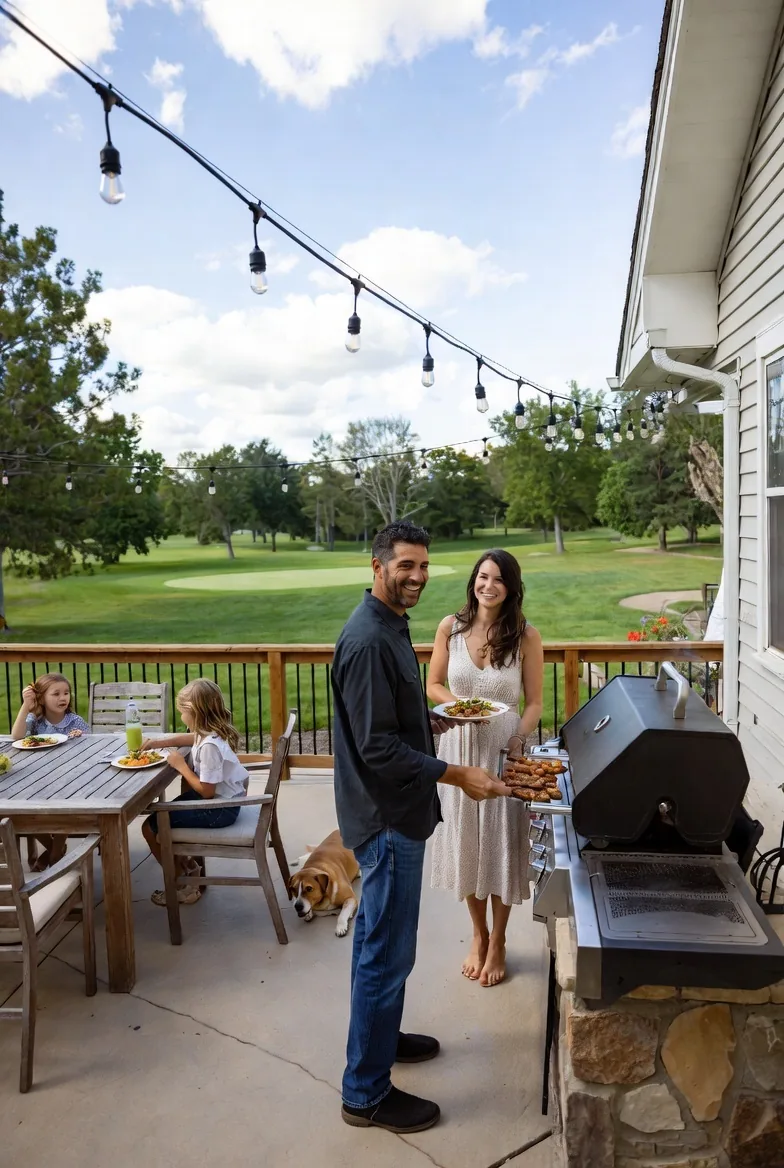
You paid real money for a stainless steel grill. Two summers into life in Fairhope, Daphne, Gulf Shores, or Spanish Fort, there are orange freckles across the lid, rust weeping from the screw heads, and a haze on the hood that no amount of scrubbing takes off. It looks like you bought a lemon.
You almost certainly didn't. What you're looking at is chloride attack, and it is the single most common grill complaint we hear across Baldwin County. Here's what's actually happening to the metal, what you can fix yourself, and where the damage stops being cosmetic.
Stainless Steel Isn't Rust-Proof. It's Rust-Resistant.
Stainless steel doesn't resist rust because of anything in the bulk of the metal. It resists rust because chromium in the alloy reacts with oxygen to form an invisible, self-healing film on the surface called the passive layer. Scratch it, and it rebuilds itself — as long as nothing interferes.
Chlorides interfere. Salt is a chloride. According to the Specialty Steel Industry of North America, pitting corrosion happens when that passive layer breaks down at a specific point on an exposed surface — and chlorides are the classic trigger. Once a pit starts, it keeps working downward into the metal even though the surface around it still looks perfect.
That's why coastal grill rust shows up as scattered spots rather than an even sheet. Each spot is a place where salt sat on the surface long enough to punch through the film.
Why the Gulf Coast Is Harder on Grills Than Almost Anywhere Else
Three things stack up here, and they compound each other:
- Airborne salt. You don't need to be on the water. Onshore breezes carry salt mist inland and deposit it on every horizontal surface, night after night. A grill sitting on an open patio in Fairhope is collecting chloride whether or not you cooked on it.
- Humidity that never lets the metal dry. Salt only attacks when it's wet. In a climate that holds high humidity for most of the year, deposited salt stays in solution on the steel around the clock instead of sitting there as harmless dry crystals.
- Year-round cooking. Gulf Coast grills rarely get an off-season. More cook cycles mean more heat cycling, more grease, and more acidic food residue left in contact with the surface — all of which give the passive layer a harder job.
Tea Staining vs. Real Pitting
Not all discoloration is equal. A light brown or tan film across large panels — often called tea staining — is surface-level and generally cosmetic. Isolated dark spots with a rough, sunken center that you can catch a fingernail on are pits, and pits are structural. Learning to tell them apart tells you whether you have a cleaning problem or a replacement problem.
304 vs. 316: The Grade Question Nobody Asks Until It's Too Late
Most residential grills are built from 304 stainless. Marine-grade 316 adds molybdenum, which is what actually buys resistance to chloride pitting. The Nickel Institute notes that molybdenum and nitrogen improve resistance to pit initiation, while nickel slows how fast pitting and crevice corrosion spread once they start.
| 304 Stainless | 316 (Marine Grade) | |
|---|---|---|
| Molybdenum content | None | Roughly 2% |
| Chloride pitting resistance | Moderate | Significantly higher |
| Typical use | Most residential grills | Coastal and marine models |
| Cost | Lower | Higher |
| Right call within a few miles of the water | Workable with disciplined care | Preferred |
If you're shopping for a built-in right now for an outdoor kitchen near the bay or the beach, ask the dealer point blank which grade the housing, hood, and fasteners are — they're often not all the same. And read the warranty. Blaze, for example, states plainly that its warranty does not cover discoloration or rust unless there's a loss of structural integrity, and specifically names salt, humidity, and chlorine as factors. Most major brands write it the same way. Surface rust is treated as a maintenance issue, not a defect — which puts it squarely on you.
The Care Routine That Actually Works Down Here
The whole game is simple: don't let salt sit on wet steel.
- Rinse the exterior with fresh water every few weeks — more often if you're within sight of the water. This one habit does more than any product you can buy.
- Dry it after rinsing. Letting it air-dry in humid air leaves the chlorides right where they started.
- Use a stainless-specific cleaner and a microfiber cloth, wiping in the direction of the grain, not against it.
- Cover it — but only when it's completely cool and dry. A cover over a damp grill traps moisture and makes things worse.
- Empty the grease tray on a schedule. Grease holds salt and moisture against the metal and is also the leading controllable cause of grill fires.
- Address rust spots early, while they're still surface-level. Pits don't reverse.
Three Things That Make It Worse
- Chlorine bleach. Never. It's a chloride source, and putting it on stainless steel is doing deliberately what the salt air is already doing accidentally.
- Steel wool and carbon-steel wire brushes. They leave microscopic iron particles embedded in the surface. Those particles rust, and the rust spreads outward from each one. Use stainless or nylon tools only.
- Scrubbing against the grain. It opens the surface up and gives salt more places to sit.
When Rust Stops Being Cosmetic
Call someone when you see rust or corrosion at burner tubes, igniter components, or gas connections — that's a function-and-safety issue, not an appearance issue. Same for flaking or perforated heat shields, rust weeping from behind welds or seams, and pitting deep enough to feel. And if the grill is a built-in, corrosion inside the cabinet where you can't see it is common on the coast and worth a look before it reaches the gas train.
Our BBQ grill deep clean and repair starts at $239. That's a full teardown — grates, flame tamers, burners, and firebox degreased and inspected, burner ports and igniters checked, and an honest report on what's cosmetic versus what's failing. Any repair work we perform carries a 1-year workmanship warranty.
Frequently Asked Questions
Why is my stainless steel grill rusting?
Because chlorides from salt air break down the invisible chromium oxide layer that gives stainless steel its corrosion resistance. Once that passive layer is compromised at a point, corrosion starts there and keeps going. Coastal humidity keeps deposited salt wet and active, which accelerates the process considerably.
Can rust on a grill be removed?
Surface rust and tea staining usually can, using a stainless-specific cleaner and a non-abrasive pad worked with the grain. Pitting cannot be reversed — the metal is gone. Cleaning a pitted surface improves how it looks but doesn't restore it.
Is a rusty grill safe to cook on?
Light surface rust on the exterior is a cosmetic problem. Rust on cooking grates should be cleaned off before use, and grates that are flaking should be replaced. Corrosion at burners, gas connections, or igniter components is a different matter and should be inspected before you light it.
Should I buy a 316 marine-grade grill in Baldwin County?
If you're within a few miles of the water and buying a built-in you plan to keep a decade, yes — the extra cost is easier to justify than replacing a corroded unit. If you're farther inland or buying a cart-style grill, 304 with a disciplined rinse-and-cover routine holds up fine.
How often should a coastal grill be professionally cleaned?
Once a year is a reasonable baseline for a grill used regularly, and it matters more on the coast than inland — a deep clean is when someone actually looks at the burner tubes and cabinet interior where salt corrosion hides.
Get It Looked At Before Grilling Season Peaks
If your grill has started showing rust and you're not sure whether it's cosmetic or the beginning of a real problem, we'll tell you straight. Book online, call the Gulf Coast line at (251) 272-1990 (DFW: (817) 791-4606), or iMessage "GRILL" to 817-946-8206. Veteran-owned, serving Fairhope, Daphne, Gulf Shores, and all of Baldwin County since 2009.