
1st Choice Residential journal
Why Your Fireplace Smells in the Summer (and How to Make It Stop)
Your fireplace hasn't been lit since February, so why does it reek in July? The real cause, the DIY fixes worth trying, and what finally ends it.
You haven't lit a fire since February. It's 101 degrees outside, the air conditioner has been running all day, and every time you walk past the living room you catch it: old campfire, wet ashtray, something sour. Nothing is wrong with your nose. That smell is real, it's coming out of your fireplace, and in North Texas it shows up almost exclusively in July and August.
Here's what's actually happening, what you can try yourself this weekend, and what it takes to make it stop for good.
The smell is creosote. Summer just turned the volume up.
Every wood fire you burned last winter left residue on the inside of your flue. It's called creosote, and it's tar, soot, and unburned wood particles baked onto the masonry or the liner. Creosote has a sharp, acrid, campfire-ash smell, and it sits up there quietly all winter because cold air is dry air.
Then summer arrives. Warm air holds far more moisture than cold air, and that humidity soaks into the creosote, the soot, and anything else living in your flue: leaves, twigs, an abandoned bird nest. Damp organic material smells. That's why the same chimney that was odorless in January is offensive in July.
Our climate makes it worse than most. We run air conditioning eight months a year, and Dallas-Fort Worth gets humidity spikes that push dew points into the 70s.
Why the smell comes into the room instead of going up
This is the part most homeowners miss, and it's the more important half of the problem.
A chimney is supposed to move air one direction: up and out. In summer, your house reverses it. Your air conditioner, bathroom fans, kitchen vent hood, and clothes dryer all pull air out of the house. That leaves the inside of your home slightly short on air, so it pulls replacement air from wherever it can find it. Your chimney is a wide-open pipe to the outside.
Air comes down the flue, and it brings every bit of that damp creosote smell with it. It's the reason the odor is worst on the hottest days: that's when the AC runs hardest.
So there are really two things to fix. What's smelling, and why it's being pulled indoors.
The four common causes, and what each one smells like
| Cause | What it smells like | What fixes it |
|---|---|---|
| Creosote and soot buildup | Campfire, ash, sharp and acrid | Professional sweep with camera inspection |
| Rain getting in an uncapped flue | Musty, wet basement, mildew | Chimney cap |
| Animal nest or a dead animal | Rotting, ammonia, distinctly organic | Removal, then a cap to keep them out |
| Negative air pressure in the house | Any of the above, but only when the AC runs | Sealing damper, plus fixing the source smell |
What you can try this weekend
- Close the damper. Sounds obvious. Most people leave it open all year without thinking about it. A closed throat damper won't seal perfectly, but it cuts the airflow considerably.
- Clean out the firebox. Old ash holds moisture and smell. Scoop it out, vacuum with a shop vac, wipe the box down. Never use water on masonry that still has ash in it, you'll make a paste that stains.
- Crack a window on the far side of the house. If the smell drops noticeably, you've confirmed negative pressure is your delivery mechanism.
- Set a bowl of baking soda or activated charcoal in the firebox. This is a comfort measure, not a repair. It buys you a few weeks.
What we'd skip: air fresheners sprayed up the flue, and burning candles in the firebox. Neither addresses the cause, and one of them is a fire risk.
What actually ends it
If the DIY list didn't work, the smell source is above the firebox and out of reach, which is where the real answer lives.
1. A sweep and camera inspection
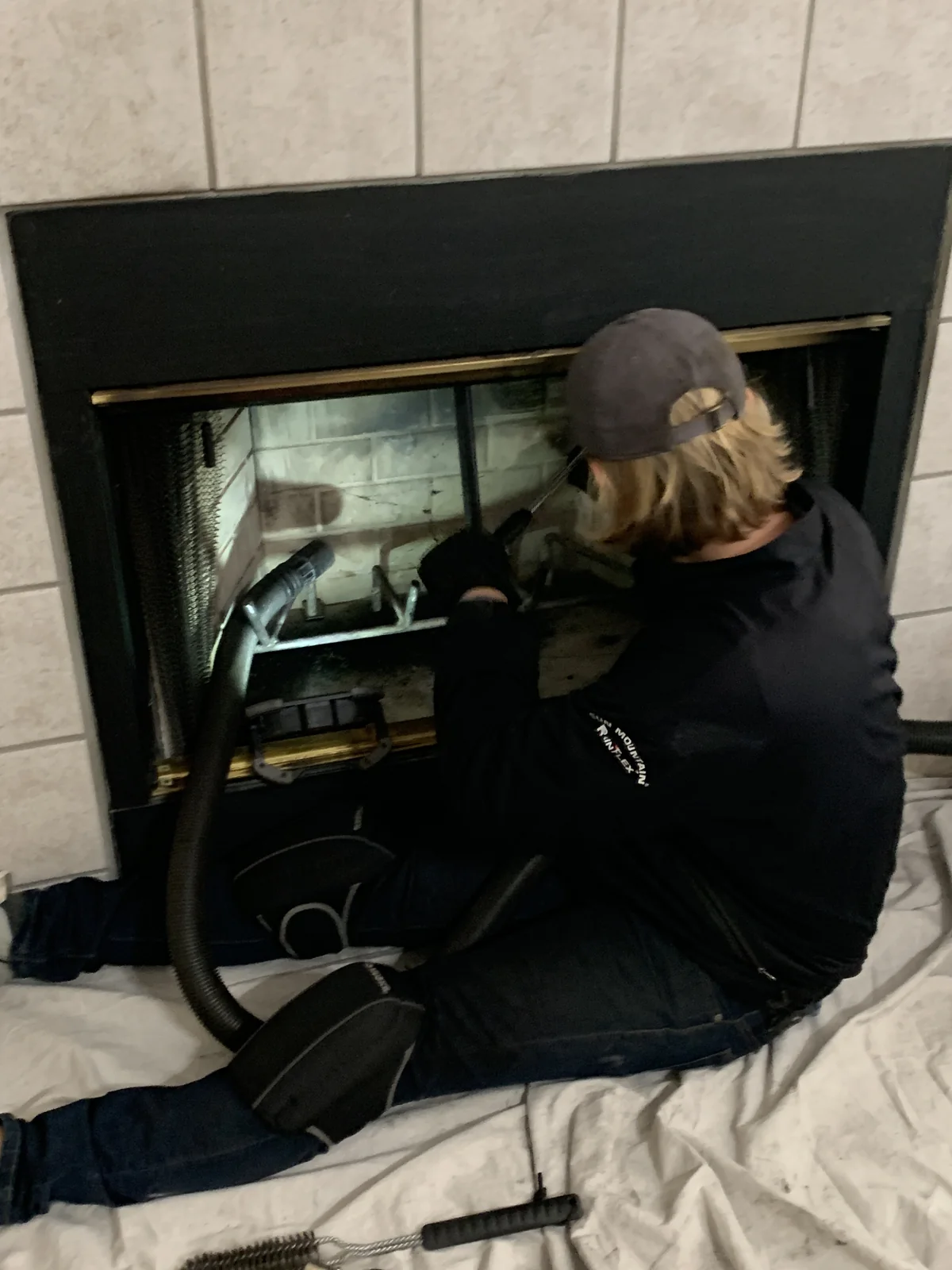
Removing the creosote removes the smell, because the creosote is the smell. A camera inspection at the same time tells you whether anything else is up there: a cracked flue tile, a nest, a missing cap, a liner that's separating. The Chimney Safety Institute of America recommends an annual chimney inspection regardless of how much you burn, and NFPA 211, the national standard for chimneys and vents, calls for the same yearly inspection.
Our chimney sweep and camera inspection is $199, and it comes with a 1-year workmanship warranty.
2. A cap, if you don't have one
An open flue is an open invitation: rain, leaves, squirrels, birds. Rain is the sneaky one, because water plus soot equals a musty smell that no amount of sweeping will fully stop until the water stops coming in. A chimney cap starts at $99 and solves three problems at once.
3. A top-sealing damper, for stubborn cases
If you've swept the flue, capped it, and the smell still creeps in on hundred-degree days, the fix is to seal the flue at the top rather than the throat. A top-sealing damper closes with a gasket at the crown, which stops the downdraft cold. It's a bigger investment than a cap, and it's the right call for homes where negative pressure is severe.
Do it now, not in October
Summer is the correct time for this work, and not just because of the smell. Every chimney company in Dallas-Fort Worth is booked solid from the first cold snap through New Year's. In July, you get your pick of appointment times. And if the inspection turns up something real, like a cracked flue or a failed liner, you have months to deal with it instead of scrambling in November with a house full of company coming.
Common questions
Why does my fireplace only smell in the summer?
Humidity. Creosote and soot in your flue absorb moisture from warm summer air, which releases the odor. In winter, dry cold air keeps that same residue from smelling. Your air conditioner then creates negative pressure that pulls the odor down the chimney and into the room.
Will cleaning my chimney get rid of the smell?
Usually yes, because creosote is the source of the odor in most homes. A sweep removes it. If the smell persists after a cleaning, the cause is typically water entry through an uncapped flue or an animal nest higher up, both of which a camera inspection will find.
Is a smelly chimney dangerous?
The odor itself isn't harmful, but it's a signal. Heavy creosote buildup is the leading cause of chimney fires, and a downdraft strong enough to carry smell into your home can also carry combustion gases when you do light a fire. It's worth an inspection.
How much does it cost to fix a smelly fireplace in DFW?
Most cases are solved by a $199 chimney sweep with camera inspection. If the flue is uncapped, add a chimney cap from $99. Homes with severe negative-pressure issues may need a top-sealing damper, which we'll quote after the inspection tells us what's actually going on.
Can I just close the damper and forget about it?
It helps, and it's worth doing. But a standard throat damper is a metal plate resting on metal, not a seal. Air still moves past it, and the creosote is still up there getting damp. Closing the damper is a bandage on a problem that takes about an hour to actually fix.
Get it handled before fall
If your fireplace has been announcing itself every time the AC kicks on, one visit usually ends it. We'll sweep the flue, run a camera up the full length, tell you exactly what's up there, and give you a straight answer on whether you need anything beyond the cleaning.
Book online, or call us. DFW: (817) 791-4606. Gulf Coast: (251) 272-1990. You can also text 817-946-8206.
1st Choice Residential is veteran-owned and has served Dallas-Fort Worth and the Gulf Coast since 2009.