
1st Choice Residential journal
Cracked Flue Tiles: Why You Can't See Them, and What a Camera Finds
A flashlight shows you three feet of a twenty-foot flue. Why cracked flue tiles hide from you in Baldwin County, and what a camera scan actually finds up there.
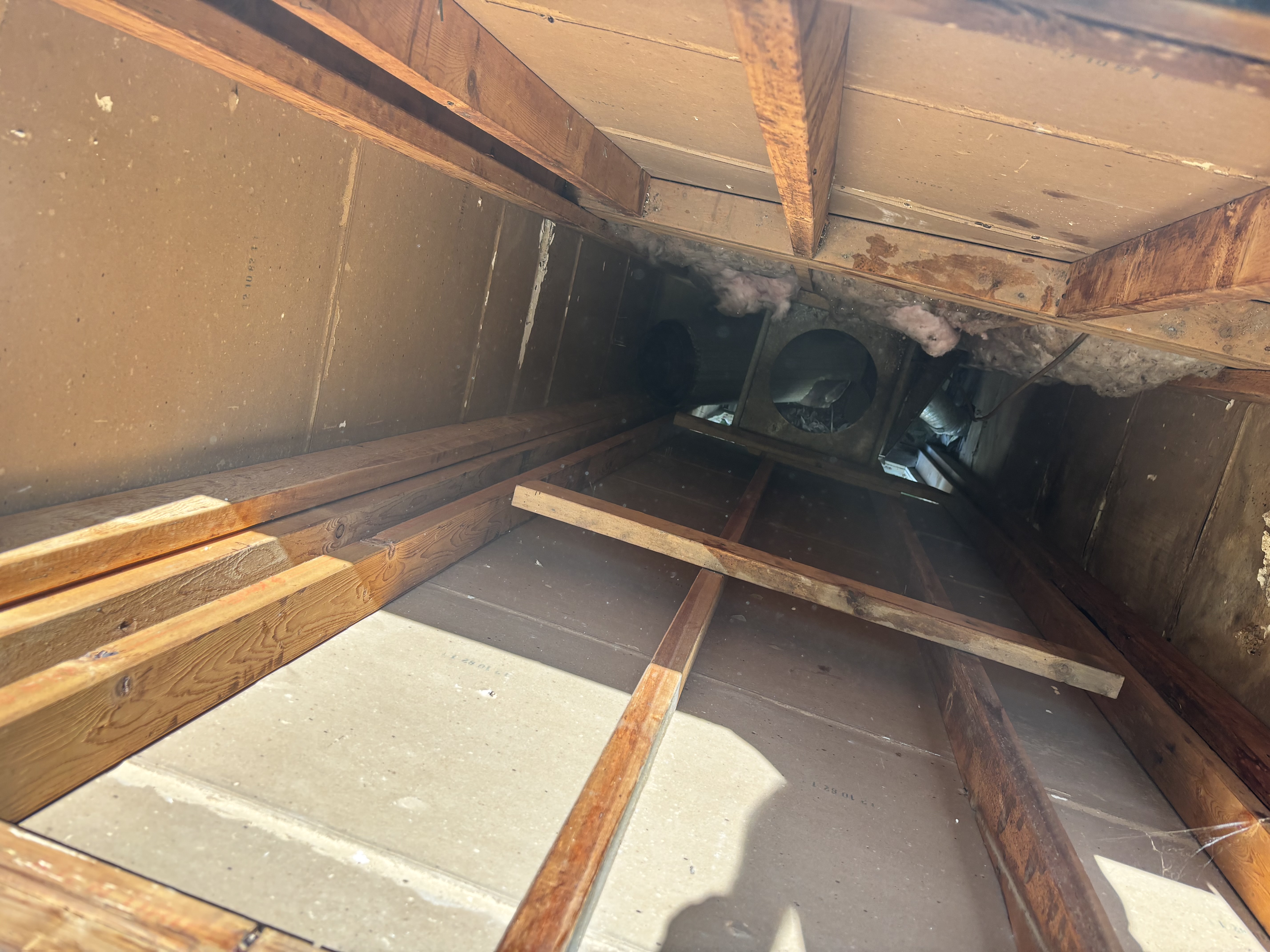
You stuck your head in the firebox with a flashlight. Looked straight up. Saw brick, saw a little soot, saw daylight way up at the top. Nothing looked broken. So the chimney's fine, right?
Maybe. But here's the problem with that flashlight test: from the firebox, you can see about three feet of a twenty-foot flue. And in Baldwin County, the damage that matters almost never happens in the part you can see. It happens ten or fifteen feet up, behind the smoke chamber, where water has been working on the mortar joints between your flue tiles for years.
What the flue liner is, and why it matters
Inside your masonry chimney is a stack of clay tiles, each about two feet tall, mortared end to end. That's the liner. The brick you see outside is the structure. The liner is the safety system. It does three jobs:
- Keeps heat off your house. The liner holds combustion heat inside the flue and away from the wood framing that runs right up against your chimney in the wall and attic.
- Keeps combustion gases inside the flue. That includes carbon monoxide. A gap in the liner is a path for it to leave the chimney and enter a wall cavity, an attic, or a bedroom.
- Gives creosote nowhere to hide. A smooth, intact liner sweeps clean. A cracked one collects deposits in the gaps.
The Chimney Safety Institute of America puts the risk plainly: when water gets into a chimney, the result is cracks or gaps where creosote can collect and increase fire risk, or where noxious gases can escape into the home.
Why you can't see flue damage from the firebox
Look up from the firebox and you're looking through the damper into the smoke chamber. The smoke chamber is a funnel — it narrows, then turns. Your line of sight ends there. Everything above that point is invisible from inside the house:
- The first tile, where the liner meets the smoke chamber — a common failure point
- Every mortar joint between every tile up the stack
- Hairline cracks running vertically down a tile face
- Tiles that have shifted or separated at a joint
- Gaps where a liner passes an adjacent wall or an attic penetration
Looking down from the top of the chimney isn't much better. You see the top tile and a dark hole. CSIA makes the same point about post-fire damage: joint failure and structural cracking "oftentimes cannot be seen from above or below."
The three ways flue tiles fail on the Gulf Coast
Up north, chimneys crack from freeze-thaw. Down here that's rare. Baldwin County chimneys fail differently, and it's worth knowing which one you're dealing with.
| Cause | What it looks like on camera | How fast it happens |
|---|---|---|
| Water intrusion — failed crown, no cap, bad flashing | Washed-out mortar joints, white mineral deposits, soft or missing bed joints between tiles | Years. Usually the most advanced damage we find. |
| Chimney fire — a creosote flue fire, sometimes one the homeowner never noticed | Sharp, clean cracks across tile faces; displaced tiles; heat-glazed surfaces | Minutes. One event does it. |
| Age and settling — 40+ year old chimney, foundation movement | Vertical cracks, tiles out of alignment at a joint | Decades, gradually. |
Water is the big one here. Our summers run humid, our storms run sideways, and salt air off the bay is hard on the metal parts up top — the cap, the chase cover, the flashing. When those go, water runs down inside the flue and quietly eats the mortar between your tiles. By the time anything shows up in the firebox, there's usually a lot going on above it.
What a camera inspection actually shows
After we sweep the flue — and it has to be swept first, because soot hides everything — we run a camera on rods up the chimney and rotate the lens to look at each component. That's the process CSIA describes: flue tiles checked for cracks, mortar joints checked to make sure they didn't fail.
| What a flashlight tells you | What the camera tells you |
|---|---|
| The firebox looks okay | Condition of every tile and every joint, top to bottom |
| There's some soot | How much creosote, what stage, and where it's collecting |
| Light comes through from the top | Whether the liner is continuous or has a gap |
| Nothing | Whether water is actively entering, and roughly where |
You get photos. If something's wrong, you see it on the screen yourself.
Signs that make a camera inspection worth doing now
You don't need all of these. Any one is a reason to look.
- You've had a chimney fire, or a loud roaring/cracking event you couldn't explain. CSIA advises not using the chimney until it's been swept and evaluated.
- Pieces of clay or grit in the firebox. Small orange or tan fragments on the smoke shelf are tile spalling off somewhere above.
- Water in the firebox, or a damper that's rusted stiff. Water is getting in. Start at the chimney cap and crown.
- Rust stains in the fireplace area. CSIA's director of education calls these "the tip of an iceberg" — by the time you see them below, damage above is likely critical.
- You're buying or selling the house. A standard home inspection does not include a flue scan.
- The chimney hasn't been inspected in years and you're about to start burning. NFPA 211 calls for chimneys to be inspected annually.
A note on buying and selling
NFPA 211 defines three inspection levels. A Level 2 — which includes a video scan of the flue interior — is the one called for when a property changes hands or after an event that could have damaged the chimney. It's a standard, not Alabama law. But it's the reason our home sale inspection includes the camera instead of treating it as an upsell.
What it costs
Our chimney sweep and camera inspection is $199 across Baldwin County — Fairhope, Daphne, Foley, Gulf Shores, Spanish Fort, Bay Minette. That's the sweep and the full flue scan together, with photos.
Repairs are quoted after we look. Relining a flue, rebuilding a crown, and replacing three tiles are completely different jobs at completely different prices, and quoting any of them sight-unseen would just mean surprising you later. A chimney cap starts at $99 — often the cheapest way to stop the water that caused the problem in the first place.
Frequently asked questions
Is a cracked flue tile dangerous?
It depends on the crack. A single hairline crack in one tile with the mortar joints intact is monitored, not an emergency. A crack that opens a path from the flue to the surrounding masonry is a real hazard — it lets heat and combustion gases, including carbon monoxide, reach spaces they shouldn't. The only way to tell which one you have is to see it.
How do I know if my chimney liner is cracked?
You usually can't, from inside the house. The reliable indicators are indirect: clay fragments on the smoke shelf, water in the firebox, rust stains, a chimney fire in the past, or a chimney that's never been scanned. A camera inspection is the only method that actually answers the question.
Can I still use my fireplace with a cracked flue?
Not until it's been evaluated. CSIA's guidance after any suspected chimney fire is to stop using the chimney until a qualified professional has swept and inspected it, because joint failure and cracking often can't be seen from either end.
How often should a chimney be inspected in Baldwin County?
Once a year, per NFPA 211 — even if you only burn a few times a winter. Down here the case for annual inspection is less about creosote volume and more about water. A chimney that sits unused through a Gulf Coast summer can take on more damage than one that gets burned regularly up north.
Does a home inspector check the flue?
Generally no. A standard home inspection looks at the fireplace and the exterior of the chimney. It does not include a camera scan of the flue interior, which is why chimney problems show up so often after closing.
Get eyes on your flue before burn season
1st Choice Residential has been doing this on the Gulf Coast since 2009. We're veteran-owned, locally owned rather than a franchise, licensed and insured, and our technicians are NFI-certified. Every job carries a one-year workmanship warranty. You'll see the camera footage yourself, and if your flue is in good shape, we'll tell you that and go home.
Book online: schedule a sweep and camera inspection
Gulf Coast: (251) 272-1990 · DFW: (817) 791-4606 · Text us: 817-946-8206
Serving Baldwin County, Fairhope, and the surrounding Gulf Coast.