
1st Choice Residential journal
Natural Gas vs. Propane Built-In Grills in DFW: Which Should You Put in Your Outdoor Kitchen?
Natural gas or propane for a built-in grill in DFW? Real BTU and pressure differences, gas line and permit rules, conversion limits, and how to decide fast.
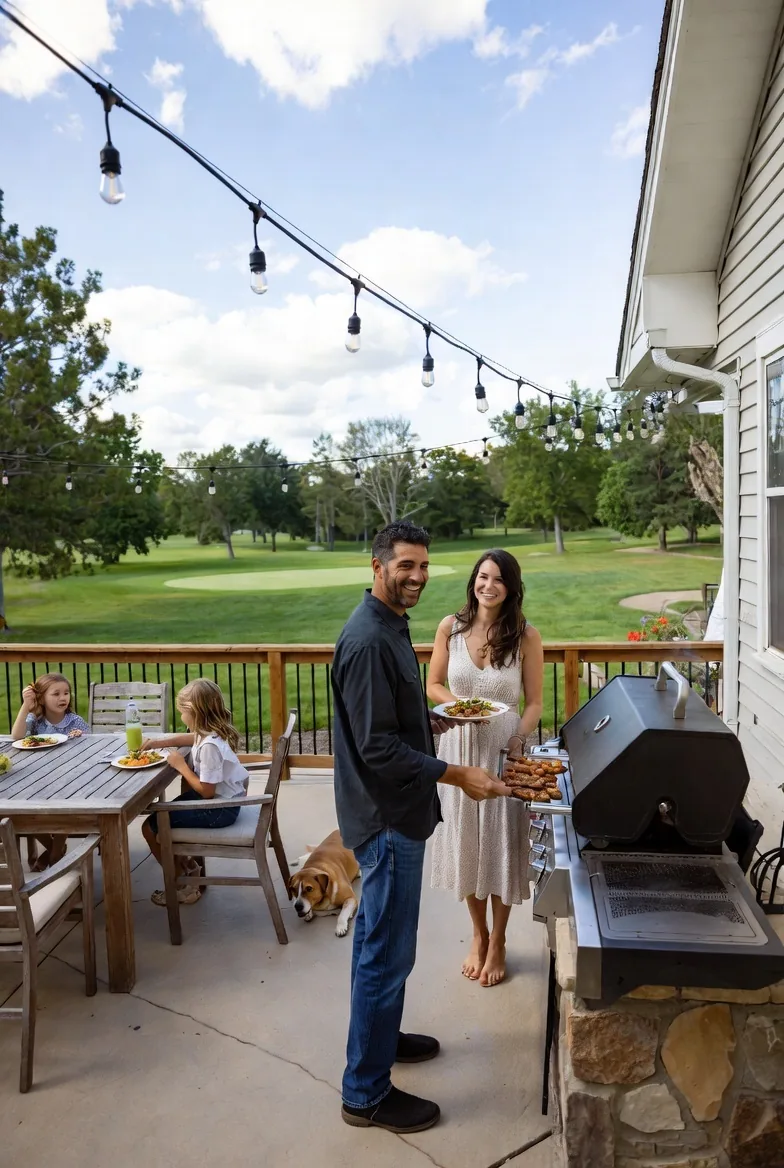
You are standing in front of two built-in grills that look identical. Same brand, same stainless, same burner count. One is stamped NG and one is stamped LP. Or maybe the island is already out back, the old grill is shot, and you are deciding whether this is the moment to run a gas line instead of hauling another propane tank home.
This is one of the few grill decisions that is hard to undo. Pick wrong and you are either paying a plumber later or swapping tanks for the next fifteen years. Here is the straight version.
The short answer
If your house already has natural gas service and the grill is going into a permanent island that will never move, natural gas is usually the better long-term call. You pay once to get gas out there, and you never think about fuel again.
If the grill sits in a cart, if you rent, if your outdoor kitchen is far from the house, or if you are on a well-and-septic property with no gas main on the street, propane wins on practicality - and it is not a downgrade. It burns hotter per cubic foot and it goes wherever you go.
What actually separates the two fuels
The differences are not marketing. They are physics, and they are the reason you cannot just screw a house gas line onto a propane grill.
Natural gas carries roughly 1,000 BTU per cubic foot. Propane carries roughly 2,500 BTU per cubic foot - more than twice the heat in the same volume. Propane also arrives at the burner at higher pressure. To get the same cooking output, a natural gas grill has to move a lot more gas through noticeably larger orifices.
| Natural gas (NG) | Propane (LP) | |
|---|---|---|
| Heat content | ~1,000 BTU per cubic foot | ~2,500 BTU per cubic foot |
| Typical appliance pressure | ~3.5-7 in. water column | ~10-11 in. water column |
| Burner orifices | Larger | Smaller |
| Fuel supply | Piped from the street - never runs out mid-cook | Tank you refill or exchange |
| Up-front cost | Gas line, permit, licensed plumber | Just the grill and a tank |
| Can the grill move? | No - it is hard-piped | Yes |
| Behavior of a leak | Lighter than air - rises and disperses | Heavier than air - settles into low spots |
The real cost of going natural gas in DFW
The grill is the small number. The gas line is the real one, and it depends almost entirely on distance and what sits between your meter and your patio. A short run off an existing stub on the back wall is a very different job than trenching sixty feet across a yard with a pool deck in the middle.
Two things are not optional in Texas. Gas piping has to be installed by a licensed plumber - you can verify any license through the Texas State Board of Plumbing Examiners in about a minute. And a new gas line requires a permit and an inspection in essentially every DFW city. Anybody offering to "just run you a line" without either one is handing you a problem you will inherit at closing when you sell.
We are a fireplace, chimney and grill company, not a plumbing company. We will service and repair the grill all day long - the gas line itself should go to a licensed plumber, and we will tell you that every time.
The real cost of staying on propane
Propane costs nothing up front and a little bit forever. The honest way to compare is not price per gallon against price per therm - different units, different amounts of heat. The U.S. Energy Information Administration spells out the right method: convert both to dollars per million BTU. EIA also notes residential propane carries a premium partly because it has to be trucked in smaller quantities, while natural gas comes down a pipe already in the ground.
For most piped-gas households, natural gas wins on running cost. Whether it wins by enough to justify a plumbing bill comes down to how often you actually cook out there. Grill twice a summer, skip the gas line. Grill four nights a week and you will stop noticing the plumbing bill by year two.
Can I just convert my grill?
Sometimes. Not usually as cheaply as you hope, and with some brands, not at all.
- Some premium built-ins are convertible with a manufacturer conversion kit - new orifices, and depending on the model, a different regulator and valve components. That kit has to come from the manufacturer for your exact model.
- Many brands prohibit it outright. Weber, for example, does not allow conversions or sell conversion kits, citing safety, the complexity of the gas train, and the level of disassembly required. Converting voids the warranty.
- Universal orifice kits off a marketplace are a bad idea. An orifice sized by guesswork gives you either lazy yellow flames and soot, or an over-fired burner. Neither is something you want inside a masonry island.
Before you buy a grill you plan to convert later, check the manufacturer's own documentation for your model number. If it does not say convertible, treat it as not convertible.
Built-in islands: the safety difference nobody mentions
This one matters more than the fuel-cost math. Propane is heavier than air. If it leaks, it does not float away - it settles into the lowest enclosed space it can find, which in an outdoor kitchen is the sealed cabinet under your grill. That is exactly why manufacturers specify ventilation openings in LP grill enclosures, and why NFPA 58, the Liquefied Petroleum Gas Code, governs how LP containers are stored and handled.
If your island is a solid stucco box built around a propane tank with no vents, fix that regardless of which fuel you end up on. Natural gas is lighter than air and rises, which is a real advantage in an enclosed island - but it is not a license to skip the vents either.
How to decide in about two minutes
- Is there already a gas meter on the house? No gas service, no natural gas grill. Done.
- Will this grill ever move? If yes, propane.
- How far is the island from the meter? Under about twenty feet is usually an easy plumbing job. Across the yard is not.
- How often do you really cook out there? Weekly or more, natural gas pays back. A few times a year, it does not.
- Are you buying new or converting? Buying new for the fuel you want is almost always cheaper and safer than converting.
Frequently asked questions
Does a natural gas grill cook worse than propane?
No, as long as it was built as a natural gas grill. A properly sized NG grill delivers its rated BTUs. The problem only shows up when a propane grill has been fed natural gas without correct orifices - then you get weak, lazy flames and long preheats. If your NG grill has always run cool, the issue is usually orifices, regulator pressure, or clogged burner ports, not the fuel itself.
How much does it cost to run a gas line to an outdoor kitchen in DFW?
It varies too much to quote honestly in a blog post - distance, pipe sizing, whether the run is trenched or overhead, and your city's permit fee all move the number. Get two written bids from licensed plumbers and make sure both include the permit and inspection.
Can I use a propane grill with my house natural gas line?
Not without a manufacturer-approved conversion for that specific model. The orifices are sized for a different fuel at a different pressure, so the grill will run badly and it will not be to code.
Do built-in grills need to be cleaned differently than portable ones?
They need it more. A built-in sits in a masonry island that traps grease, and the burners and igniters are harder to reach, so problems go unnoticed longer. Our grill deep clean starts at $239 and includes pulling and cleaning the internals, not just scrubbing the grates. See BBQ grill cleaning and repair for what is covered.
Which fuel is safer?
Both are safe when installed and vented to spec. Natural gas has an edge in an enclosed island because it rises rather than pooling. Propane's advantage is that there is no permanent pressurized line running under your yard. Either way, if you ever smell gas, shut the supply off and get out before you troubleshoot anything.
Not sure what you have, or whether it is worth keeping?
Before you spend money on either fuel, have someone look at the grill you already own. Plenty of built-ins written off as dead need burners, orifices and a real deep clean, not replacement.
1st Choice Residential has been servicing grills, fireplaces and chimneys since 2009. Veteran-owned, licensed and insured, locally owned rather than a franchise, NFI-certified technicians, and a one-year workmanship warranty on every job. We serve Dallas-Fort Worth including Southlake, plus Mobile and Baldwin County on the Gulf Coast.
- Grill deep clean: from $239
- DFW: (817) 791-4606
- Gulf Coast: (251) 272-1990
- Text or iMessage: 817-946-8206
Book a grill service online and tell us which fuel you are on - it changes what we bring.